
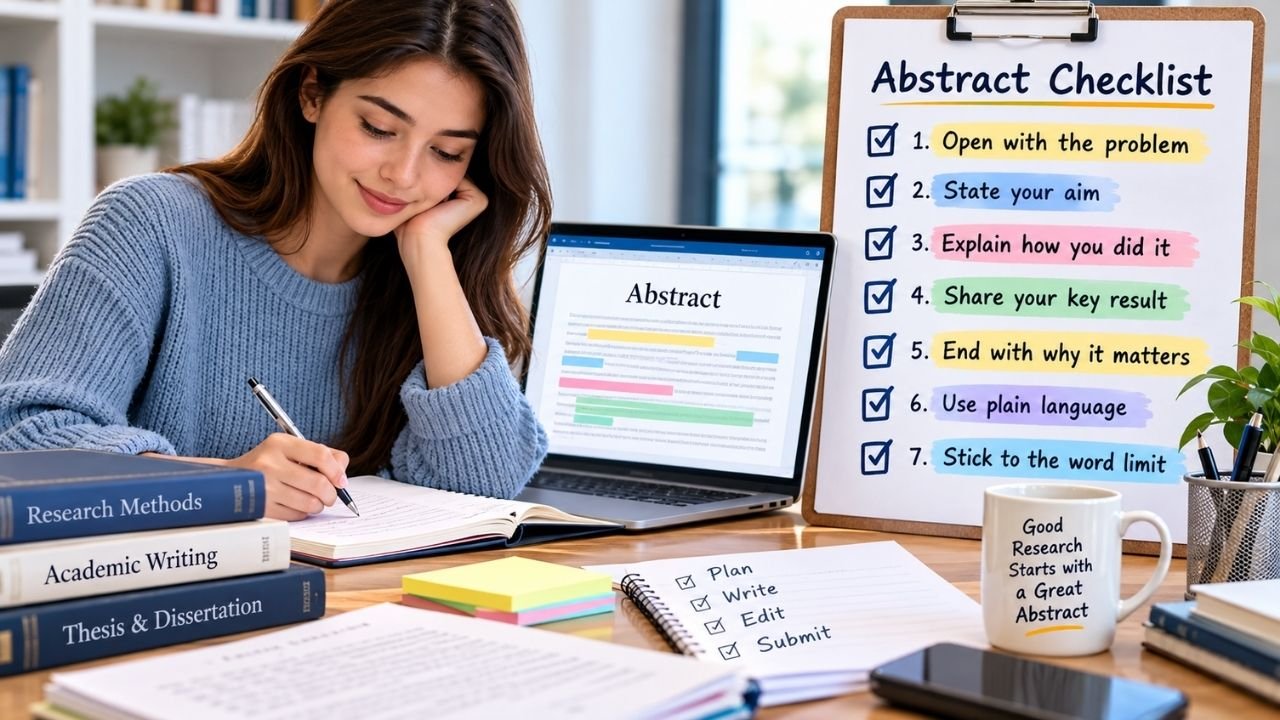
Think about how you look for papers. You search, scroll past a pile of titles, skim a few abstracts, and open maybe one. That’s about how much time your own abstract gets. For markers and reviewers, it’s usually the first thing they read, and it’s a mood-setter for the rest of the book.
Fortunately, you’ll not need fancy handwriting to get it right. You just need the right things, in the right order. Here’s a checklist that makes it pretty simple.
Why You Only Get a Few Seconds
Generally, the abstract is presented first in a database or search engine and it is the abstract that will help the reader determine whether your paper is worth reading. A clear one gets your work found and understood. A vague one gets skipped, even if the research behind it is brilliant. It’s your paper’s first impression, and you don’t get a second go.
So, What Does a Good Abstract Actually Do?
It’s a concise summary that stands by itself. It should be easy for someone to read and understand what you were looking at, how you looked at it, what you saw, and why it is important.
Most students require an informative abstract — one that tells about what you really found—which is not a descriptive abstract that simply tells what the paper is about. However, before you start, be sure to review your brief or journal instructions! The rules and word limits vary from one location to another.
The 7-Point Abstract Checklist
1. Open with the problem
Don’t waste time on the history lesson. Explain in a sentence or two, why your topic is important.
2. State your aim
Tell readers what you set out to do. “This study looks at…” is a perfectly good start.
3. Explain how you did it
Keep it short: your approach, who or what you studied, and the main tools.
4. Share your key result
Give a real finding. “Results are discussed” doesn’t tell anyone anything.
5. End with why it matters
Wrap up with the takeaway in one sentence.
6. Use plain language
Leave out jargon, unexplained abbreviations, and citations. If someone outside your field can follow it, you’re doing well.
7. Stick to the word limit
Trim until every sentence has earned its spot.
If your abstract is solid but the rest of your dissertation still needs work, a professional thesis writing service can help you build a strong paper around it.
Weak vs Strong: A Quick Example
Here’s a made-up example.
Weak: “This paper looks at social media and students. Various factors are explored, and the results are discussed.”
Strong: “Many students use social media late at night, but its effect on sleep is unclear. Students who used social media for over 2 hours before going to sleep said their sleep quality was poorer. The findings suggest that simple limits on late-night use could support student wellbeing.”
Spot the difference? The strong one tells you what was done, what was found, and why anyone should care. The weak one just points at a topic and hopes for the best.
Mistakes That Trip Students Up
These come up again and again:
- Writing the abstract first, then never updating it when the paper changes
- Copying sentences straight from the introduction
- Adding things that aren’t actually in the paper
- Leaving out the findings
- Running way over the word limit
A simple one is to write it at the end, after you’ve figured out what your paper actually says. Write a sentence for each checklist item and cut it apart. It helps to read it aloud and if someone who is not the subject can read it, then you are on the right track.
Your 60-Second Final Check
Before you submit, ask yourself:
- Does it cover the problem, aim, method, result, and why it matters?
- Is there at least one specific finding?
- Is it within the word limit and free of jargon?
- Does it make sense without the rest of the paper?
Once your abstract is finished, it’s worth asking a reliable thesis editing services team to check that the rest of your paper actually matches the promise your abstract makes.
Final Thought
The ideal abstract is brief, simple and to the point. Write it last, use the checklist, and test it on someone who hasn’t read your paper. The quality of your work depends on a few well-crafted sentences, and you don’t have to be a genius writer to be a genius writer. All you have to do is be honest and clear about what you found.
