
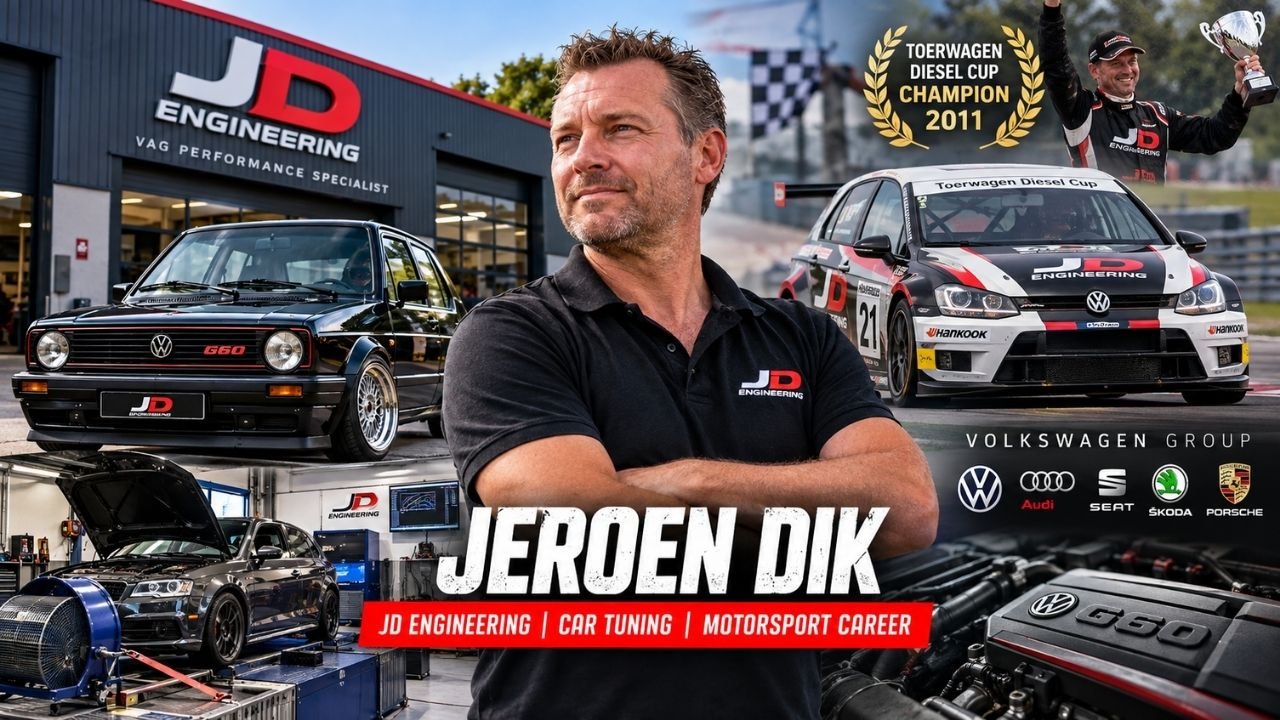
Jeroen Dik is a Dutch automotive tuning specialist, entrepreneur, and racing driver best known for his long association with JD Engineering, a performance-tuning company based in Lochem, the Netherlands. Over several decades, Dik has built his professional reputation around Volkswagen Group vehicles, engine-management software, performance optimization, and competitive motorsport.
Unlike automotive personalities whose reputations are driven primarily by television or social media, Jeroen Dik built his name through hands-on tuning work. His career began during the 1990s, when he became particularly involved with Volkswagen performance cars and G60 engines. What started as an interest in modifying vehicles eventually developed into a specialized automotive business.
JD Engineering became known for its work on numerous G60 models and a Volkswagen Golf 1 16V G60 project that won multiple sprint competitions. As demand for specialist tuning grew, Dik turned it into a full-time operation.
Motorsport is another significant part of the Jeroen Dik story. His experience wasn’t limited to preparing and tuning cars for other drivers. Dik competed himself and achieved notable success in Dutch touring-car racing, including winning the Toerwagen Diesel Cup championship in 2011.
Here is a detailed look at Jeroen Dik, JD Engineering, his tuning career, motorsport achievements, and his place in the Volkswagen Group performance community.
Who Is Jeroen Dik?
Jeroen Dik is a Dutch automotive performance specialist closely associated with JD Engineering. The company specializes in tuning Volkswagen Group vehicles, particularly Volkswagen, Audi, SEAT, Škoda, and Porsche models.
According to JD Engineering’s official company history, Dik began tuning cars during the 1990s. His work with Volkswagen’s G60 models became an important part of the company’s early development.
This specialization matters for understanding his career. Rather than covering every manufacturer and engine platform, JD Engineering developed deep expertise in a particular family of vehicles.
Modern Volkswagen Group cars depend heavily on electronic management systems. Consequently, extracting additional performance involves considerably more than replacing mechanical components. Diagnostic equipment, software calibration, engine-management knowledge, testing, and an understanding of individual engines all play a role.
These are areas that became central to the professional identity associated with Jeroen Dik and JD Engineering.
Jeroen Dik and the Beginning of His Tuning Career
Jeroen Dik’s career dates back to the 1990s.
It was an interesting period in European performance-car culture. Electronic engine management was becoming increasingly important, but enthusiasts were still heavily involved with mechanical modifications, forced induction, engine conversions, exhaust systems, suspension upgrades, and other hands-on performance projects.
According to JD Engineering, Dik started tuning vehicles in this period and quickly became associated with numerous Volkswagen G60 models.
The G60 occupies an interesting position in Volkswagen performance history. It used a distinctive G-Lader supercharger, providing enthusiasts with opportunities to modify boost, fueling, airflow, engine management, and other components.
Working with these vehicles required understanding how different modifications interacted. Simply increasing boost or changing one component could affect engine temperatures, fueling requirements, reliability, and drivability.
Dik’s experience with these cars eventually contributed to the development of a specialized tuning operation.
The Famous Golf 1 16V G60 Project
One of the early projects particularly associated with Jeroen Dik and JD Engineering was a Volkswagen Golf Mk1 equipped with a 16V G60 configuration.
JD Engineering describes the Golf 1 16V G60 as a significant car in its history and says that it won numerous sprint competitions. The success of this project contributed to the growing recognition of Dik’s tuning work.
Competition cars can provide valuable experience for a tuner because racing exposes components to conditions considerably more demanding than ordinary commuting.
An engine that performs well for a few seconds on a dynamometer does not necessarily deliver the same results during repeated hard use. As demands increase, cooling, fueling, boost control, drivetrain strength, and consistency become increasingly important.
This connection between workshop development and competitive use would remain an important theme throughout Jeroen Dik’s professional career.
Jeroen Dik and JD Engineering
JD Engineering eventually became the business most closely associated with Jeroen Dik.
Based in Lochem, the Netherlands, the company specializes in Volkswagen Group vehicles. Its official information lists Volkswagen, Audi, SEAT, Škoda, and Porsche among the marques it tunes.
According to the company, its concentration on VAG vehicles has allowed it to develop extensive technical knowledge of the group’s products and use VAG-specific diagnostic and programming equipment.
This specialized approach makes sense in modern automotive tuning.
Today’s cars are sophisticated electronic systems. The engine control unit communicates with numerous sensors and other vehicle modules. Changing engine behavior therefore requires understanding not only horsepower but also torque management, boost pressure, fueling, ignition, temperature, emissions-related systems, and drivetrain limitations.
For this reason, professional tuning increasingly combines mechanical understanding with software and data analysis.
What Does JD Engineering Specialize In?
JD Engineering is best known for performance tuning and software optimization for Volkswagen Group cars.
Chip tuning or ECU calibration involves modifying parameters within an engine’s electronic control software. Depending on the engine and application, calibration can influence factors such as boost control, fueling, ignition timing, throttle behavior, and torque delivery.
However, tuning should not be seen as simply finding the maximum possible horsepower figure.
Every engine, turbocharger, gearbox, fuel system, and cooling system has operating limits. Modifications also need to account for a particular vehicle’s condition and configuration.
JD Engineering emphasizes its use of specialist diagnostic and programming equipment when developing VAG engine tuning.
The company also operates a four-wheel-drive rolling road, or dynamometer, at its Lochem facility. This equipment lets tuners measure vehicle performance under controlled conditions and evaluate the effects of calibration or hardware changes.
Why Volkswagen Group Cars Became Central to Jeroen Dik Career
Volkswagen Group vehicles have built enormous enthusiast communities worldwide.
Volkswagen models such as the Golf GTI and Golf R have long attracted drivers interested in performance modifications. Audi’s turbocharged models have similarly become popular tuning platforms, while performance vehicles from SEAT, Škoda, and Porsche broaden the wider Volkswagen Group ecosystem.
Many vehicles within the group share engines, transmissions, electronics, or underlying platforms, although the exact configuration can differ significantly between models.
Specializing in this ecosystem allowed Jeroen Dik and JD Engineering to build experience across generations of related technology.
The nature of that work has also changed considerably over time.
A tuner working on a 1990s Volkswagen faces very different technical challenges from someone calibrating a modern turbocharged engine with sophisticated electronic controls. Remaining active across multiple generations therefore requires continuous adaptation.
Jeroen Dik Motorsport Career
Jeroen Dik’s career extends beyond the workshop into competitive motorsport.
He became particularly associated with the Toerwagen Diesel Cup, a Dutch touring-car competition involving diesel-powered racing vehicles.
Motorsport provided a logical extension of his tuning background. A race environment tests not only outright performance but also consistency, reliability, vehicle setup, driver skill, and the ability to perform repeatedly under demanding conditions.
Dik achieved one of his most notable racing accomplishments in 2011, when he won the Toerwagen Diesel Cup championship.
Contemporary and later automotive coverage records that Dik had finished second in the championship in 2010, narrowly missing the title by one point. He returned the following season and secured the championship.
Jeroen Dik’s 2011 Championship
The 2011 season represents a particularly important chapter in Jeroen Dik’s motorsport story.
He competed with a Volkswagen Golf 5 and finished the season at the top of the Toerwagen Diesel Cup standings.
Published championship information gives Dik 211 points, putting him comfortably ahead of the closest competitors in the final standings.
The championship also demonstrated an interesting connection between his two professional worlds.
As a tuner, Dik worked on vehicle performance and engine management. As a racing driver, he experienced the practical consequences of vehicle setup directly from behind the steering wheel.
Motorsport places performance engineering under continuous pressure. Engines operate under heavy loads, brakes repeatedly experience high temperatures, tires must be managed carefully, and drivers need predictable power delivery.
For an automotive performance specialist, racing offers a different perspective than workshop testing alone.
From G60 Cars to Modern ECU Tuning
One of the most interesting aspects of Jeroen Dik’s career is the span of technology it covers.
His tuning history reaches back to Volkswagen G60 vehicles from the 1990s, while JD Engineering today works with much newer Volkswagen Group platforms.
The difference between these generations is substantial.
Older performance projects could depend heavily on mechanical changes. Modern cars combine mechanical components with sophisticated software controlling almost every aspect of engine operation.
Turbocharger behavior, fueling, ignition, emissions systems, transmission behavior, traction management, and torque requests can all interact electronically.
As a result, modern performance tuning increasingly requires specialized diagnostic tools and detailed software knowledge.
JD Engineering’s emphasis on VAG-specific diagnostic and programming equipment reflects this evolution.
Why Dyno Testing Matters in Performance Tuning
A dynamometer is a key tools in professional performance development.
Rather than judging improvements purely by subjective driving impressions, a rolling road lets technicians collect measurable data.
Depending on the equipment and testing procedure, technicians can examine power and torque output while monitoring relevant engine data.
Testing also lets technicians compare results before and after modifications.
For a tuning company, this measurement-based approach matters because two apparently identical cars may not perform the same. Mileage, maintenance, mechanical condition, fuel quality, modifications, and environmental conditions can influence results.
JD Engineering’s facility includes an in-house SuperFlow four-wheel-drive rolling road.
Reliability and Performance
Performance tuning always involves balancing different objectives.
Customers naturally want noticeable improvements, but maximum power is not necessarily the only goal. A road car still needs to function in everyday conditions.
Drivability, heat management, fuel quality, transmission capability, engine condition, and component limits all matter.
This explains why specialist knowledge can become valuable in automotive tuning. Experience with many examples of the same engine or platform helps technicians understand common weaknesses and how particular vehicles respond to modification.
Vehicle owners should also remember that modifying factory software or hardware can affect reliability, emissions compliance, warranty coverage, insurance, and road legality, depending on the vehicle and jurisdiction.
Performance modifications should therefore be approached with appropriate technical and legal considerations.
Jeroen Dik Influence in the VAG Enthusiast Community
Jeroen Dik’s recognition comes primarily from the specialist automotive world rather than mainstream celebrity culture.
His name is particularly relevant to enthusiasts researching Volkswagen performance, Audi tuning, ECU calibration, and JD Engineering.
His career has lasted a long time. Automotive technology has changed dramatically since the 1990s, moving from comparatively straightforward performance modifications toward increasingly software-driven vehicles.
JD Engineering says it has become a recognized name among Volkswagen, Audi, SEAT, Škoda, and Porsche enthusiasts, reflecting the specialist reputation the business has built.
That history also explains why searches for Jeroen Dik frequently overlap with terms such as “JD Engineering,” “Volkswagen tuning,” “VAG tuning,” and “Jeroen Dik racing.”
Is Jeroen Dik an Engineer, Tuner, or Racing Driver?
Online profiles sometimes use different professional descriptions for Jeroen Dik.
The clearest description based on JD Engineering’s own material is that he is the owner of JD Engineering and an experienced automotive tuner. His documented motorsport record also establishes his background as a racing driver.
Precise descriptions matter because online biographies sometimes add professional titles without primary evidence.
What is clear is that Dik has decades of hands-on involvement in vehicle tuning, Volkswagen Group products, performance software, and motorsport.
Jeroen Dik and Joris Dik Are Different People
Another important point for anyone researching Jeroen Dik online.
Search results can include information about similarly named individuals, and some secondary websites mix unrelated professional backgrounds.
The Jeroen Dik associated with JD Engineering is known through automotive tuning and motorsport.
Researchers should therefore avoid combining his biography with information belonging to academics or other professionals with similar names.
For an accurate biography, focus on information directly connected to Jeroen Dik through JD Engineering, established automotive coverage, or motorsport records.
Why Is Jeroen Dik Still Searched Online?
The long-lasting popularity of Volkswagen Group performance cars can explain interest in Jeroen Dik.
Enthusiasts continually search for information on tuning specialists, historic Volkswagen projects, racing drivers, ECU calibration, and companies with long track records on specific vehicle platforms.
Dik’s career intersects with all of these topics.
He began during an era dominated by projects such as modified G60 Volkswagens, helped develop JD Engineering into a specialized tuning business, and later demonstrated his connection with motorsport through touring-car competition.
His story offers a glimpse into the broader evolution of European automotive tuning.
What began with mechanical modification and early electronic engine-management technology has evolved into a highly software-dependent industry that requires sophisticated diagnostic, programming, and measurement equipment.
Conclusion
Jeroen Dik has built a distinctive career combining automotive performance tuning, entrepreneurship, Volkswagen Group specialization, and motorsport. Starting with car tuning in the 1990s, he became particularly associated with Volkswagen G60 models and the notable Golf 1 16V G60 sprint project.
Those early projects helped develop JD Engineering, which became a full-time specialist operation in Lochem, the Netherlands. Today, the company focuses on Volkswagen Group vehicles, including Volkswagen, Audi, SEAT, Škoda, and Porsche, using specialized diagnostic, programming, and performance-testing equipment.
Dik also took his automotive experience into competitive racing. His 2011 Toerwagen Diesel Cup championship remains one of the clearest achievements of his motorsport career and demonstrates that his connection with performance cars extends beyond workshop tuning.
Ultimately, Jeroen Dik’s story is closely tied to the evolution of Volkswagen performance culture. From modified G60 cars and sprint racing to sophisticated ECU calibration and modern VAG vehicles, his career spans decades of technological change.
Whether you’re interested in Jeroen Dik, JD Engineering, Volkswagen tuning, VAG performance, or Dutch motorsport history, his mix of hands-on tuning experience and racing success helps explain why his name still draws attention in the automotive community.
You May Also Read: Erica Enders Net Worth: Career, Earnings, Championships and Racing Success
