
Introduction
Sound quality plays an important role in how people enjoy music, movies, podcasts, and other forms of entertainment. Whether someone listens to music through headphones, uses a home audio system, or works with professional recording equipment, controlling sound can make a significant difference. One technology that helps achieve a better listening experience is the quad equalizer.
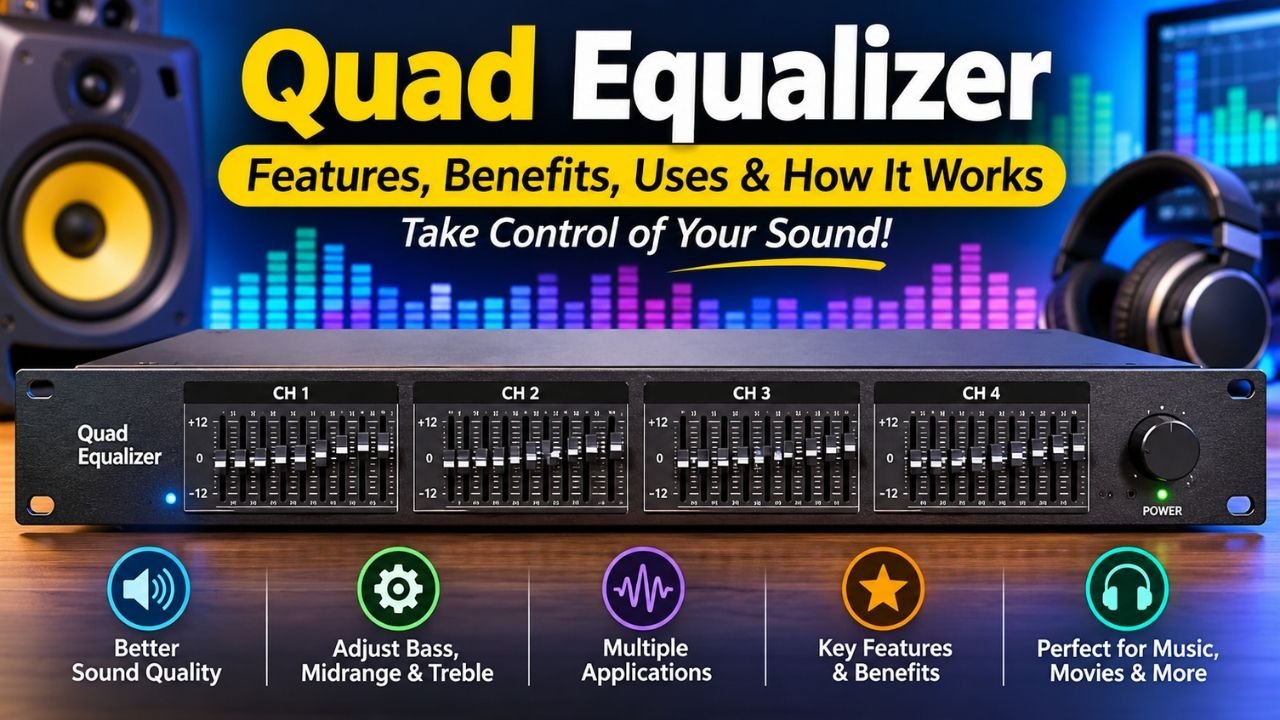
A quad equalizer is an audio-related term generally associated with equalization systems that provide four frequency bands or four independent audio-processing channels. These systems allow users to adjust different aspects of sound, including bass, midrange, and treble. By making suitable adjustments, listeners and audio professionals can create a more balanced and enjoyable audio experience.
Quad equalizers are relevant to several areas of audio technology, including car entertainment systems, recording studios, home theaters, and professional sound equipment. Understanding how they work, what features they offer, and where they are used can help people make informed decisions when exploring audio equipment.
This article explains everything readers should know about quad equalizers, from their basic functions to their benefits, applications, and future developments.
What Is a Quad Equalizer?
A quad equalizer is generally an audio equalization system designed around four adjustable frequency bands or four separate audio channels. Its primary purpose is to give users greater control over an audio signal, so they can modify the sound to match their preferences or technical requirements.
An equalizer, commonly known as an EQ, is a device or software feature that changes the volume of selected frequency ranges. For example, someone who enjoys bass-heavy music might increase the lower frequencies, while someone who prefers clearer vocals might adjust the middle frequencies.
The word “quad” means four, but its exact meaning depends on the equipment. In a basic four-band equalizer, it refers to four frequency controls. In some professional audio products, it can describe four independent processing channels.
Understanding this distinction is important when researching a particular quad equalizer or comparing different audio devices.
How Does a Quad Equalizer Work?
A quad equalizer separates an audio signal into different frequency ranges and lets users adjust each range independently.
Every sound contains different frequencies. Deep bass sounds occupy lower frequencies, while high-pitched sounds occupy higher frequencies. An equalizer changes the strength of selected frequencies without necessarily changing the entire audio signal equally.
For example, imagine listening to a song where the bass is too strong, and the vocals are hard to hear. Adjusting the low-frequency band downward and making a small midrange adjustment may improve the overall balance.
Most equalization systems offer controls such as:
- Frequency selection
- Gain adjustment
- Bandwidth control
- Preset sound profiles
- Independent channel settings
The exact controls depend on whether the equalizer is analog, digital, graphic, or parametric.
Understanding the Four Main Frequency Bands
A four-band equalizer typically divides sound into four broad frequency regions. Each region contributes something different to the listening experience.
Low Frequencies
Low frequencies are responsible for bass and deep sounds. They include bass guitars, kick drums, and low musical notes.
Increasing this range can make music feel fuller and more powerful. However, excessive bass can make audio sound muddy or overpower other instruments.
Low-Mid Frequencies
The low-midrange contributes warmth and fullness to music. It plays an important role in the sound of many instruments and lower-pitched voices.
Too much energy in this region can make recordings sound crowded. Reducing it slightly may help improve separation and clarity.
High-Mid Frequencies
High-mid frequencies contribute to vocal presence and instrument definition. They help listeners hear important details in guitars, vocals, and other musical elements.
Careful adjustments can make speech easier to understand and instruments more noticeable.
High Frequencies
High frequencies provide brightness, sparkle, and detail. Cymbals, certain vocal details, and high-pitched instruments contain energy in this region.
Increasing the treble can make music sound more detailed, but excessive boosting may create harshness or listening fatigue.
Different Types of Quad Equalizers
Quad equalizers can come in different designs depending on their intended purpose and the level of control they provide.
Graphic Equalizers
Graphic equalizers use separate controls to adjust specific frequency ranges. They are popular because their interfaces are relatively easy to understand.
Users can increase or decrease individual frequency levels using sliders or digital controls. Graphic equalizers are commonly found in live sound equipment, home audio systems, and professional recording environments.
Parametric Equalizers
Parametric equalizers offer more detailed control over sound. They allow users to adjust the center frequency, gain, and bandwidth of individual frequency bands.
This makes them useful for correcting specific sound problems, removing unwanted resonances, and improving the balance of professional recordings.
Digital Equalizers
Digital equalizers process audio signals through digital technology. They may include customizable settings, visual frequency displays, automatic adjustments, and saved presets.
Digital systems are particularly useful for sound engineers who need accurate and repeatable settings.
Analog Equalizers
Analog equalizers use electronic circuits and physical controls to change audio frequencies. They remain popular in certain professional recording environments because of their familiar interfaces and traditional signal-processing characteristics.
Important Features of a Quad Equalizer
When researching a quad equalizer, it helps to understand the features that affect its performance and usability.
Some important features include:
- Frequency control: Allows users to modify selected parts of the audio spectrum.
- Gain adjustment: Determines how much a frequency range is increased or reduced.
- Channel management: Helps control different audio channels independently.
- Preset storage: Allows users to save settings for future use.
- Real-time analysis: Displays information about the frequencies present in an audio signal.
- High-pass filtering: Reduces unwanted low-frequency content.
- Low-pass filtering: Reduces unwanted high-frequency content.
- Stereo linking: Allows two channels to share adjustments when operating as a stereo pair.
Not every quad equalizer includes all these features. Buyers should review individual product specifications before deciding.
What Is the Mackie Quad EQ?
One well-known product associated with the keyword quad equalizer is the Mackie Quad EQ.
It is a professional digital graphic equalizer designed primarily for live sound applications. Unlike a simple four-band equalizer, the Mackie Quad EQ provides four independent channels, each with 30 bands of Adaptive-Q graphic equalization.
This distinction makes the product an important example of how the word “quad” can refer to the number of processing channels rather than the number of frequency bands.
Some of its notable features include:
- Four independent digital equalizer channels.
- Thirty-band Adaptive-Q equalization per channel.
- Built-in real-time analyzer (RTA).
- Measurement microphone support.
- Pink noise generator.
- High-pass and low-pass filters.
- Stereo linking for selected channel pairs.
- Storage for up to 99 user snapshots.
- Professional XLR and TRS connections.
These features make it useful for sound engineers who need to manage multiple audio channels and adjust sound in live performance environments.
The Mackie Quad EQ is an older product and is no longer listed as available through some major audio retailers. People considering a used unit should inspect its physical condition, connections, controls, display, and included accessories.
Benefits of Using a Quad Equalizer
A quad equalizer offers several advantages for people who want greater control over audio quality.
Improved sound balance: Users can adjust frequency ranges to create a more balanced sound. This is particularly useful when certain frequencies dominate the audio.
Better vocal clarity: Carefully adjusting midrange frequencies can help make speech and singing more noticeable.
Enhanced bass control: Users can increase or reduce bass according to their preferences and the capabilities of their speakers.
Greater flexibility: Multiple controls allow users to customize audio for different types of music, recordings, and listening environments.
Professional sound management: Advanced models support multiple channels, allowing sound engineers to manage complex audio systems.
Convenient settings: Digital models may offer preset storage, making it easier to return to previously successful configurations.
Although these benefits are useful, an equalizer cannot solve every audio problem. It can improve frequency balance, but it cannot completely repair damaged recordings, severe distortion, or poor-quality source material.
Common Applications of a Quad Equalizer
Quad equalizers are relevant to several audio applications.
Car Audio Systems
Car audio enthusiasts often use equalizers to customize the sound of their entertainment systems. Different vehicles have different acoustic characteristics, and speaker placement can influence the listening experience.
An equalizer can help adjust bass, vocals, and treble to create a more comfortable sound.
Home Entertainment Systems
Home theater users may adjust equalization to improve dialogue clarity, music playback, and overall sound balance.
A suitable EQ setting can help compensate for certain room acoustics, although proper speaker placement and room treatment are also important.
Recording Studios
Recording engineers use equalizers to shape vocals, instruments, and other audio elements.
For example, reducing unwanted low-frequency energy can help prevent a recording from sounding muddy. Adjusting the presence region can also help instruments and vocals become more distinguishable.
Live Music Performances
Concerts and public performances require careful sound management. A professional equalizer helps technicians adjust frequency response, control feedback, and manage multiple speaker channels.
Digital Music Production
Music producers frequently use equalizer plugins inside digital audio workstations. These tools provide detailed frequency adjustments without requiring separate physical hardware.
Quad Equalizer vs. Other Equalizer Systems
Different equalizer systems provide different levels of control. Understanding these differences can help users choose the right equipment.
| Equalizer type | Main characteristics |
| Two-band equalizer | Basic bass and treble controls |
| Four-band equalizer | Four broad frequency adjustments |
| Ten-band equalizer | More detailed frequency control |
| Thirty-one-band equalizer | Fine adjustments across many frequency ranges |
| Parametric equalizer | Adjustable frequency, gain, and bandwidth |
A four-band equalizer is often suitable for straightforward sound customization. A larger graphic equalizer provides more precise control, while a parametric equalizer is useful for targeted frequency adjustments.
The best choice depends on the user’s experience, equipment, and audio requirements.
How to Set Up a Quad Equalizer
Setting up a quad equalizer does not have to be complicated. However, following a few basic steps can help users achieve better results.
- Check compatibility: Make sure the equalizer supports the audio equipment and connections you intend to use.
- Connect the equipment: Follow the manufacturer’s instructions for connecting inputs and outputs.
- Start with flat settings: Keep the equalizer at its neutral position before making adjustments.
- Play familiar audio: Choose a recording that you know well.
- Adjust individual frequencies: Make small changes to the frequency ranges that need improvement.
- Listen carefully: Compare the adjusted sound with the original signal.
- Save suitable settings: If the equipment supports presets, store useful configurations for future use.
Avoid making large adjustments immediately. Small changes often produce more natural results.
How to Choose the Right Quad Equalizer
Choosing the right quad equalizer depends on how and where it will be used. Some people need a simple device for listening to music, while others require professional equipment for recording or live performances.
Consider the following factors before purchasing:
1. Intended application: Determine whether you need an equalizer for car audio, home entertainment, studio recording, or live sound.
2. Number of channels: Check whether the device provides four frequency bands or four independent audio channels.
3. Frequency adjustment options: Look for sufficient control over the frequency ranges you want to modify.
4. Connectivity: Examine the available input and output connections, including XLR, TRS, and other supported formats.
5. Ease of operation: Beginners may prefer simple controls, while experienced audio professionals might benefit from advanced digital features.
6. Build quality: Consider the materials, control durability, and overall reliability of the equipment.
7. Budget: Compare different models and evaluate their features before making a purchase.
Taking these factors into account can help users find equipment that meets their audio requirements.
Common Mistakes to Avoid When Using a Quad Equalizer
Although equalization can improve sound quality, incorrect settings may produce disappointing results.
Some common mistakes include:
- Increasing bass levels too much.
- Boosting every frequency band simultaneously.
- Making adjustments without listening to the original recording.
- Ignoring speaker limitations.
- Using the same settings for every listening environment.
- Confusing four-channel equalization with four-band equalization.
- Making unnecessary changes to an already balanced recording.
One best practice is to start with a neutral setting and adjust only the frequencies that genuinely need improvement.
It is also important to remember that reducing problematic frequencies can sometimes produce better results than boosting others.
Quad Equalizer and Modern Audio Technology
Audio technology continues to evolve, and equalizers have become more advanced over time.
Traditional equalizers relied heavily on physical sliders, knobs, and switches. Modern digital systems provide additional features that make sound adjustment more convenient and accurate.
Today, many audio applications include visual frequency analyzers, customizable equalization curves, automatic room correction, and saved sound profiles.
Artificial intelligence and automated audio-processing technologies are also influencing how people manage sound. These tools can help identify frequency imbalances and suggest adjustments based on particular listening environments.
However, traditional equalizers remain valuable because they provide direct control over audio signals. Many professional engineers continue to use manual equalization alongside modern digital processing tools.
The quad equalizer concept therefore remains relevant to the broader development of audio equipment and sound customization.
Frequently Asked Questions About Quad Equalizer
What does quad equalizer mean?
A quad equalizer generally refers to an audio equalization system associated with four adjustable frequency bands or four independent audio-processing channels. The precise meaning depends on the equipment.
Is a quad equalizer good for music?
Yes. It can help users adjust bass, midrange, and treble to create a sound profile that matches their preferences.
How many bands does a quad equalizer have?
A four-band equalizer has four adjustable frequency bands. However, professional products such as the Mackie Quad EQ have four channels, each containing multiple frequency bands.
Can a quad equalizer improve car audio?
Yes. A compatible equalizer can help customize a car’s audio system by adjusting different frequency ranges. Its effectiveness depends on the speakers, installation, and acoustic environment.
What is the difference between a graphic and parametric equalizer?
A graphic equalizer generally provides fixed frequency controls, while a parametric equalizer allows more detailed adjustments to frequency, gain, and bandwidth.
The Future of Equalizer Technology
The future of equalization is closely connected to developments in digital audio processing.
As audio devices become more sophisticated, users can expect additional features that simplify sound customization. Automated sound analysis, intelligent frequency correction, and improved digital signal processing are already important parts of modern audio technology.
Software-based equalizers are also becoming increasingly accessible. Music producers, content creators, and everyday listeners can use them to adjust sound without purchasing expensive professional equipment.
Despite these developments, the basic purpose of equalization remains unchanged: providing control over different frequency ranges to achieve a desired audio result.
Quad equalizers and other multi-band systems will continue to have a place in audio applications because they offer practical ways to manage and improve sound.
Conclusion
A quad equalizer is an important concept in audio technology because it represents a way to manage and customize sound through multiple frequency adjustments or independent processing channels. Its applications extend across car audio systems, home entertainment, professional recording studios, live performances, and digital music production.
You May Also Read: Best Wireless Earbuds Under 200 Dollars 2024: Top Picks for Sound, Comfort and Performance
