
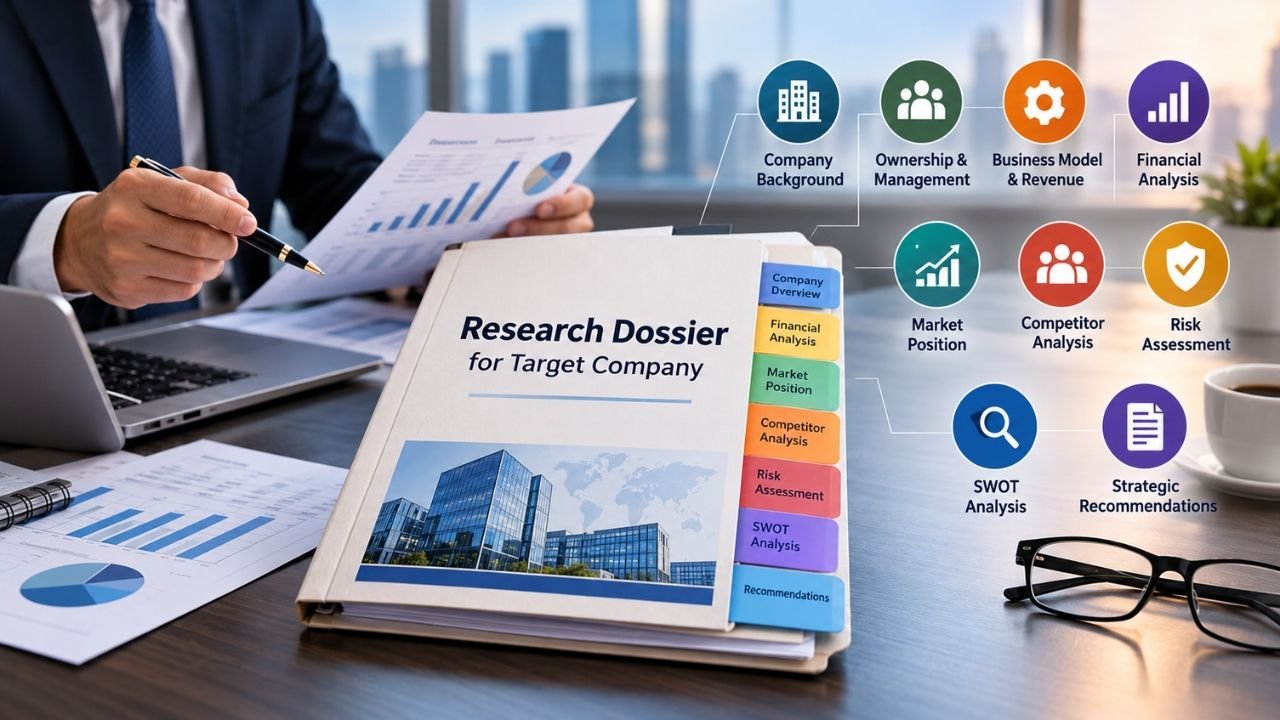
In today’s competitive business environment, making informed decisions requires accurate information, thorough research, and strategic planning. Whether an organization is considering an acquisition, exploring an investment opportunity, establishing a partnership, or entering a new market, understanding another business’s background and performance is essential. This is where a research dossier on a target company becomes a key business intelligence tool.
A research dossier provides a detailed examination of a company’s operations, financial performance, ownership structure, leadership, competitive position, market opportunities, and potential risks. Instead of relying on basic descriptions or promotional information, businesses use research dossiers to build a comprehensive understanding of an organization before making key decisions.
Preparing an effective company research dossier requires collecting information from trustworthy sources, organizing relevant findings, analyzing business performance, and clearly presenting conclusions.
This comprehensive guide explains what a research dossier for target company is, why it matters, its essential components, how to prepare one, and the benefits it provides to investors, business owners, financial analysts, and corporate decision-makers.
What Is a Research Dossier for Target Company?
A research dossier for target company is a structured document containing detailed research and analysis about a specific organization. It is designed to provide decision-makers with reliable information about the company’s background, business activities, financial condition, market reputation, and future growth potential.
The term “target company” generally refers to an organization being evaluated for a particular business purpose. This could include a potential acquisition, investment, partnership, supplier relationship, or strategic collaboration.
Unlike a simple company profile, which usually provides basic information such as location, industry, and services, a research dossier examines multiple aspects of the organization.
For example, an investment firm considering purchasing shares in a company may create a research dossier to investigate its revenue, profitability, management team, competitors, business strategy, and financial risks.
Similarly, a corporation planning to acquire another business may prepare a detailed dossier to understand whether the acquisition aligns with its strategic objectives.
The ultimate purpose is to reduce uncertainty and support informed business decisions.
Why Is a Research Dossier for Target Company Important?
Business decisions often involve financial commitments, operational challenges, and long-term responsibilities. Making these decisions without proper research can expose organizations to unnecessary risks.
A company research dossier provides several important advantages.
First, it improves decision-making by presenting verified information in an organized format. Executives can review the company’s strengths, weaknesses, opportunities, and challenges before proceeding with a transaction.
Second, it helps identify potential business risks. Financial instability, legal disputes, management problems, declining market demand, and operational weaknesses may affect a company’s attractiveness.
Third, a research dossier supports strategic planning. By understanding a target company’s market position and competitive advantages, organizations can determine whether a partnership or acquisition would create additional value.
Finally, it helps stakeholders compare multiple business opportunities using consistent evaluation criteria.
For these reasons, organizations commonly use research dossiers in corporate development, investment analysis, mergers and acquisitions, business consulting, and strategic sales planning.
Essential Components of a Research Dossier for Target Company
A comprehensive research dossier should contain several important sections. Each section helps you better understand the target company’s business environment and overall performance.
Company Background and Overview
The first section should introduce the target company and provide essential identification details.
Important information includes:
- Official company name and registration details
- Year of establishment
- Headquarters and operating locations
- Industry and business sector
- Company history and major milestones
- Products and services
- Mission, vision, and business objectives
This information provides context for the remainder of the research.
Understanding a company’s history can also show how its business model has evolved and whether it has adapted successfully to industry changes.
Ownership and Management Structure
Leadership and ownership significantly shape a company’s strategy, stability, and performance.
A research dossier should identify the company’s founders, executive leadership, board of directors, major shareholders, and, where relevant, parent organizations.
Researchers should review key executives’ professional backgrounds, prior business experience, leadership changes, and corporate governance practices.
Strong leadership and transparent ownership structures can indicate effective management, although these factors should always be evaluated alongside financial and operational evidence.
Business Model and Revenue Sources
Understanding how a company generates revenue is essential when assessing its commercial potential.
This section should explain the organization’s primary products, services, customer segments, distribution channels, pricing strategies, and sources of income.
For example, a software company may generate revenue through subscriptions, enterprise licensing, consulting, or technical support.
By contrast, a manufacturing business may earn revenue through wholesale contracts, direct sales, and international distribution.
Identifying these revenue streams helps researchers understand the company’s commercial sustainability and dependence on particular customers or markets.
Financial Analysis in a Company Research Dossier
Financial research is one of the most important elements of a research dossier for evaluating a target company.
A company’s financial performance can reveal its profitability, operational efficiency, liquidity, and capacity for future expansion.
Key financial indicators include:
Revenue: Total income generated from business operations during a period.
Net Profit: The amount remaining after expenses, taxes, and other applicable costs have been deducted.
Operating Expenses: Expenses associated with managing and maintaining the ‘sbusiness’s day-to-dayes.
Cash Flow: The movement of money into and out of the organization.
Debt and Liabilities: Financial obligations that may influence the company’s stability.
Profit Margins: Indicators showing how effectively a business converts revenue into profit.
Researchers should compare financial information across multiple reporting periods whenever possible.
For publicly listed companies, annual reports and regulatory filings often provide useful financial data.
Private companies may disclose less information, so researchers must rely on legally accessible records, voluntary disclosures, and carefully labeled estimates.
Financial estimates should never be presented as verified figures without supporting evidence.
Understanding the Target Company Market Position
A research dossier should examine how the organization performs within its industry.
Market research helps determine whether the target company operates in a growing sector, faces strong competition, or possesses advantages that distinguish it from other businesses.
Key areas to investigate include industry size, market trends, customer demand, geographic presence, competitive conditions, and potential barriers to entry.
For example, a technology company operating in the artificial intelligence industry may benefit from increased demand for automation and advanced software solutions.
However, it may also face challenges from competition, cybersecurity risks, regulatory requirements, and rapidly changing technology.
Evaluating market position enables businesses to understand the target company’s current opportunities and long-term commercial prospects.
Competitor Analysis for a Target Company
Competitor analysis is another essential element of corporate research.
It allows researchers to compare the target company with other organizations operating in the same market.
A useful competitor analysis considers product quality, pricing, customer experience, innovation, brand reputation, distribution networks, and financial strength.
Researchers should identify both direct and indirect competitors.
Direct competitors provide comparable products or services to comparable customers. Indirect competitors satisfy the same customer needs through alternative solutions.
A competitive comparison can reveal the target company’s unique selling propositions and potential weaknesses.
For example, one company may offer lower prices, while another may compete through superior technology, stronger customer support, or greater brand recognition.
Understanding these differences helps decision-makers evaluate whether the target company has a sustainable competitive advantage.
How to Prepare a Research Dossier for Target Company
Creating an effective research dossier requires a systematic approach. An organized process improves accuracy, reduces duplication, and ensures important information isn’t overlooked.
Step 1: Define the Research Objective
Begin by identifying why the research is being conducted.
A dossier prepared for an acquisition will require different information from one developed for a sales partnership.
Acquisition research may emphasize financial liabilities, ownership, contracts, and operational risks.
Sales research may focus more heavily on customer needs, purchasing decisions, company growth, and leadership responsibilities.
Clearly defining the objective helps establish the appropriate scope.
Step 2: Collect Company Information
Gather information from reliable and relevant sources.
Useful resources include official company websites, government business registries, annual reports, regulatory disclosures, investor presentations, professional directories, and established business publications.
For US publicly traded companies, the Securities and Exchange Commission’s EDGAR database is a valuable source of regulatory filings.
Researchers evaluating UK businesses can consult Companies House for company registration information and available filings.
Information should be recorded alongside its source and publication date.
Step 3: Evaluate Financial Performance
Review available financial documents and identify patterns in profitability, revenue growth, debt levels, and operating efficiency.
Where possible, compare financial performance with industry competitors.
Unusual fluctuations or declining financial indicators should be investigated before conclusions are drawn.
Step 4: Research Leadership and Ownership
Identify important decision-makers and assess the company’s governance structure.
Consider executive experience, management stability, ownership concentration, and publicly documented organizational changes.
Avoid rumors and unsupported personal claims.
Step 5: Conduct Industry and Competitor Research
Study relevant industry developments and compare the target company against major competitors.
This analysis helps identify market opportunities and business challenges.
Step 6: Identify Potential Risks
Examine potential financial, operational, legal, regulatory, technological, and reputational risks.
Document supporting evidence and distinguish confirmed concerns from possibilities that require further investigation.
Step 7: Prepare the Final Report
Organize the research into a professional document containing an executive summary, company overview, detailed analysis, findings, recommendations, and references.
The final dossier should be understandable to stakeholders who may not have participated in the research process.
Research Dossier for Target Company Template
Using a standardized template makes business research more efficient and ensures consistent reporting.
A practical company research dossier can follow this format:
| Section | Key Details |
| Executive Summary | Main findings and strategic recommendations |
| Company Profile | Name, location, history, and industry |
| Ownership Structure | Shareholders, subsidiaries, and parent organization |
| Leadership | Executives, directors, and governance |
| Products and Services | Main offerings and customer segments |
| Financial Overview | Revenue, profitability, liabilities, and cash flow |
| Market Analysis | Industry trends, demand, and growth potential |
| Competitive Analysis | Main competitors and market advantages |
| Risk Assessment | Financial, legal, operational, and reputational risks |
| Opportunities | Expansion, innovation, and partnership potential |
| Final Recommendations | Suggested actions and areas for further investigation |
| References | Supporting documents, source links, and research dates |
A standardized format also makes it easier to compare multiple target companies.
Risk Assessment and Due Diligence
Risk assessment is a critical part of preparing a research dossier.
Even businesses with strong revenue growth and attractive products may face hidden challenges.
Potential risks include financial difficulties, lawsuits, supply chain disruptions, regulatory changes, cybersecurity threats, and customer concentration.
For example, a company that relies heavily on one major customer may face significant financial problems if that customer ends its contract.
Similarly, an organization operating in a highly regulated industry may face increased compliance costs.
Researchers should evaluate both the likelihood and potential impact of identified risks.
It is also important to distinguish preliminary research from formal due diligence.
A research dossier provides an initial or intermediate assessment using available evidence. Formal due diligence may require confidential records, specialist legal reviews, independent financial verification, and direct access to company representatives.
SWOT Analysis in a Company Research Dossier
A SWOT analysis helps organize information about a target company’s internal and external business environment.
SWOT is an acronym that denotes Strengths, Weaknesses, Opportunities, and Threats.
Strengths represent internal advantages, such as an established customer base, valuable intellectual property, experienced leadership, or efficient operations.
Weaknesses include internal limitations, such as outdated technology, high operating costs, or limited financial resources.
Opportunities describe external conditions that could support growth, including emerging markets, new customer demand, or technological developments.
Threats represent external challenges, such as stronger competitors, economic instability, regulatory changes, or declining industry demand.
Including a SWOT analysis helps stakeholders better understand the target company’s strategic position.
However, SWOT findings should be supported by research, not assumptions.
Benefits of Preparing a Research Dossier for Target Company
A well-structured research dossier offers several practical benefits to organizations and professionals.
Better Investment Decisions
Investors can use company research to evaluate financial performance, market conditions, and possible returns before allocating capital.
Improved Acquisition Planning
Businesses considering mergers or acquisitions can identify operational challenges, potential synergies, and concerns that require further investigation.
Stronger Business Partnerships
Companies evaluating prospective partners can assess commercial compatibility, financial stability, and business reputation.
Reduced Business Risks
Thorough research helps identify potential problems before significant financial or contractual commitments are made.
Enhanced Strategic Planning
Understanding industry developments and competitive conditions supports long-term business planning.
Improved Negotiation Preparation
A research dossier can provide evidence that supports commercial discussions, negotiations, and transaction planning.
Overall, its greatest advantage is transforming scattered company information into a structured resource for business decisions.
Common Mistakes to Avoid When Creating a Research Dossier
Although company research is valuable, poor practices can lead to misleading conclusions.
One common mistake is relying exclusively on the company’s official website. Official websites provide important background information, but they are often designed to present the business in the best light.
Whenever possible, researchers should verify important claims using independent sources.
Another mistake is using outdated financial information. Business conditions can change quickly, so recent, properly dated information is essential.
Failing to investigate competitors can also lead to an incomplete understanding of the company’s market position.
Researchers should avoid confusing estimates with confirmed financial results.
Additionally, a dossier should not ignore negative information simply because the company appears successful.
Finally, reports should be organized logically, with clear headings, understandable explanations, and accessible references.
Best Practices for Accurate Company Research
Preparing a reliable research dossier requires professional research standards.
Researchers should prioritize primary sources, including official regulatory disclosures, audited financial reports, government records, and direct corporate announcements.
Important facts should be verified across multiple credible sources when possible.
Every significant finding should include a source reference and date so readers can assess its reliability.
Researchers should also separate factual findings from interpretation.
For example, reporting that a company’s revenue increased is a factual statement when supported by financial records. Concluding that the company has excellent long-term growth potential requires additional analysis.
Maintaining confidentiality is equally important when working with nonpublic company information.
Confidential financial records, business contracts, or personal information should be handled according to applicable laws, contractual obligations, and organizational security policies.
These practices help produce more accurate, ethical, and useful research reports.
Frequently Asked Questions About Research Dossier for Target Company
What is the main purpose of a company research dossier?
The main purpose is to gather and evaluate important information about a company so investors, business owners, and other stakeholders can make informed decisions.
Who prepares a research dossier for a target company?
Research dossiers may be prepared by business analysts, investment professionals, corporate development teams, consultants, market researchers, and due diligence specialists.
What information should a company research dossier contain?
It should generally include company background, ownership, leadership, business operations, financial information, market analysis, competitor research, risks, and strategic recommendations.
How long should a company research dossier be?
The length depends on the research objective and the target company’s complexity. A preliminary dossier may contain only a few pages, while comprehensive corporate research reports can be considerably longer.
Is a research dossier the same as due diligence?
Not exactly. A research dossier organizes company information and analysis, while due diligence generally involves more detailed verification before an investment, acquisition, or other significant transaction.
Conclusion
A research dossier for target company is an essential resource for understanding a business before making important financial, commercial, or strategic decisions. It brings together company history, ownership details, leadership information, financial performance, market conditions, competitor analysis, and potential risks into one organized report.
Whether used for investment research, acquisition planning, strategic partnerships, or corporate intelligence, a comprehensive research dossier helps organizations identify opportunities, evaluate challenges, and reduce uncertainty.
Creating a reliable dossier requires careful information gathering, financial analysis, source verification, and objective interpretation. Researchers should prioritize credible records, weigh positive and negative findings, and present conclusions clearly and accessibly.
As business markets evolve, organizations that invest in structured company research are better positioned to recognize opportunities and respond to potential challenges.
A well-prepared research dossier for target company evaluation does more than summarize business information. It provides a foundation for informed decision-making, effective risk management, and sustainable strategic growth.
You May Also Read: HMJones.net: Website Overview, Features, Business Loans, Ownership, Benefits
