

Rope access services help with building maintenance by offering a flexible, focused, and information-led alternative to large scaffolding systems and heavy machinery. They allow technicians to inspect, repair, and care for the outside of a building with very little equipment at ground level and no blockage of entrances or public areas. Professional rope access services in London by RAIL are more than a replacement for temporary access equipment. They form part of a wider building safety and inspection process. Certified technicians can reach the exact area that needs attention, find hidden faults, test for water leaks, repair structural and surface defects, and create clear maintenance records without covering the whole property in scaffolding.
London has a wide mix of buildings, from historic Portland stone terraces in Westminster to modern glass curtain walling in the City and tall residential towers around Canary Wharf. Looking after these façades requires accurate work and careful planning. RAIL connects high-level facilities management with larger repair projects, carrying out focused work that protects property value, supports legal duties, and keeps occupants safe while the building continues to operate.
Why London Buildings Need Flexible Access Solutions
London is one of the most difficult urban settings in which to carry out building work. Narrow historic streets sit beside very tall modern buildings, leaving little space for standard access equipment. Property managers must deal with busy pavements, restricted roads, borough permits, and constant traffic while protecting members of the public.
Weather patterns across the South East also bring hotter summers and wetter, windier winters. These conditions can speed up the failure of external weather seals and masonry joints. Building maintenance needs an access method that can respond quickly to seasonal damage without creating weeks of traffic, delivery, and site-management problems.
Restricted Streets, Pavements and Courtyards
Using Mobile Elevating Work Platforms (MEWPs) or crane-mounted cherry pickers in Central London can involve high costs, detailed planning, and several council permissions. Pavement licences, temporary traffic management orders (TMOs), and out-of-hours lane closures can delay urgent repairs for weeks or months. Many buildings also stand above underground vaults, rail lines, or service basements that cannot support the ground pressure created by heavy machinery outriggers.
Rope access removes most of this machinery from the street. The main working point is on the roof rather than on the pavement. Technicians move down the façade in a controlled way and need only a clearly marked, engineered drop zone at ground level. Pavements stay open, courtyards remain usable, and entrances can continue operating without the need for costly highway permits in many cases.
High-Rise Façades and Difficult-To-Reach Areas
Modern office and residential towers often have striking shapes, including sloping glass walls, deep louvers, projecting fins, and recessed balconies. These features can create areas that mechanical cradles and standard gantry systems cannot reach. Cradles follow vertical tracks and cannot always move sideways into undercuts, internal lightwells, or stepped atriums without coming into contact with the building.
Industrial rope access technicians solve these access problems with specialist rigging, such as directional pulleys, re-anchors, and lateral tension lines. They can position themselves next to façade joints, soffits, and other features while keeping their bodies and tools stable, even where the building changes angle or height.
How RAIL Supports Building Maintenance With Rope Access
RAIL provides building envelope maintenance as an access contractor and as a practical inspection and repair partner. Its field experience includes thousands of completed project hours at difficult London sites. The company combines the flexibility of rope access with technical inspection skills. Each job follows a clear process: review the client’s brief, inspect the site, carry out the agreed work, and provide detailed records after the visit.
RAIL treats access as part of the inspection and repair process rather than as a separate first step. When a fault is found, technicians reach the area, open hidden interfaces if needed, record photographic and physical evidence, complete the required repair, and give property managers clear condition information for future maintenance planning.
Building Inspections and Façade Surveys
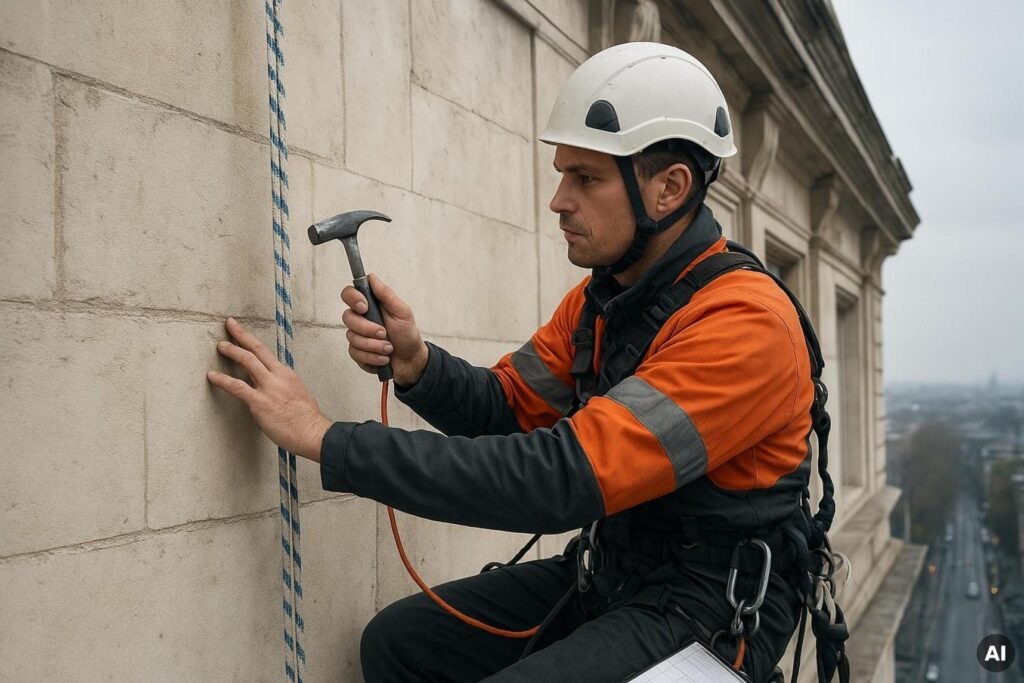
Visual checks from the ground or through long-range cameras can miss early signs of material damage. RAIL carries out close-up, hands-on condition surveys by placing experienced inspectors next to the building envelope. Technicians can perform non-destructive tests, acoustic hammer checks on stone and render, and controlled opening works where the external wall build-up needs to be confirmed.
Each survey creates detailed, location-linked photographs and digital inspection records. By recording small cracks, movement in fixings, and early signs of material wear, RAIL gives asset managers reliable information for planning future spending. Small faults can then be dealt with before they develop into serious structural problems.
Façade Repairs, Sealing and Waterproofing
Weatherproof joints are the building’s main defence against water entry. Pollution, ultraviolet light, and repeated building movement can cause flexible sealants to dry, separate from the surface, and fail. RAIL technicians repair mastic joints by removing the failed sealant, preparing the joint surfaces, and applying commercial waterproofing systems with care.
Alongside silicone sealing, teams repair masonry, restore stone, patch render, and fit custom flashings. Keeping weather seals in good condition stops hidden water movement that can damage internal finishes and corrode structural support frames.
Window, Curtain Walling and Cladding Maintenance
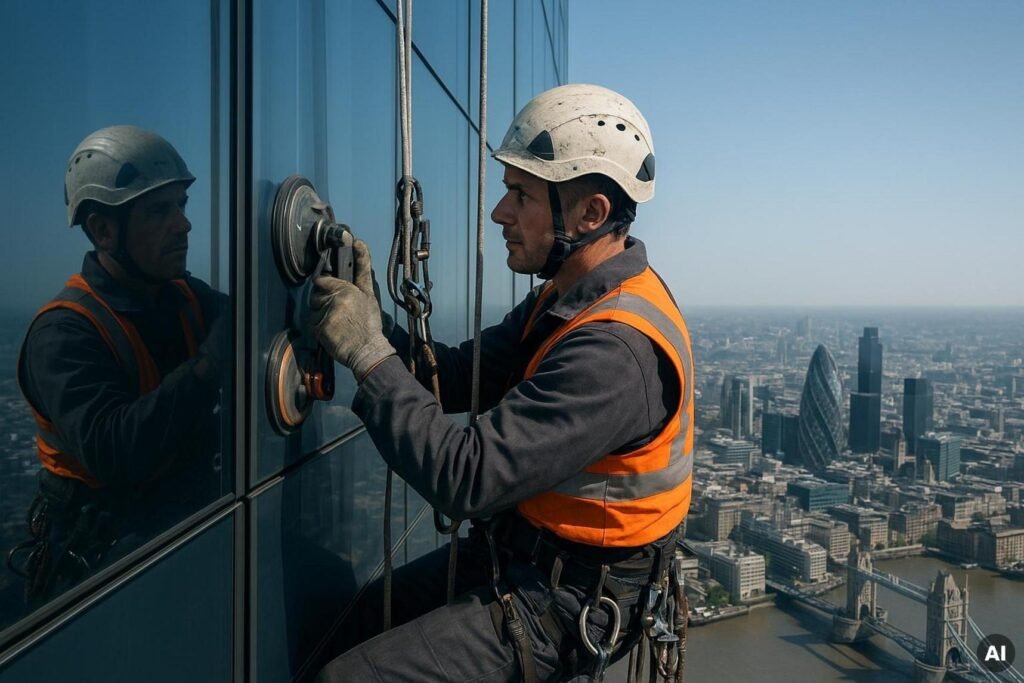
Modern curtain walling and cladding systems need regular mechanical and structural checks. RAIL helps property operators deal with post-construction issues, including reseating gaskets, realigning external pressure plates, and replacing damaged double- or triple-glazed units. Technicians use modular vacuum lifting equipment and controlled haul lines to move glass safely at great height.
Following increased checks on cladding after the Grenfell Tower fire, RAIL carries out important envelope retention tests, including vacuum-suction testing and the selective removal of rainscreen panels. Technicians inspect cavity barriers, concealed fixings, and insulation layers. After the tests, they put all parts back in place to meet the manufacturer’s requirements and current fire safety standards.
Gutter, Roofline and Drainage Maintenance
Blocked rainwater systems can quickly lead to internal flooding and damp in the structure. High-level parapet gutters, hopper boxes, and internal downpipes in London can be difficult to inspect and clean. RAIL technicians abseil into narrow roof valleys and lightwells to remove leaves, silt, and other urban debris.
The teams also carry out drainage repairs. They can line worn lead, zinc, and cast-iron gutters with seamless liquid-applied waterproofing membranes, tighten mechanical joint collars, and clear blocked downpipes. This restores the flow of rainwater across the roof system.
Cleaning, Painting and High-Level Repairs
Traffic carbon, algae, and mineral stains can make a building look neglected and may also speed up surface damage. RAIL uses specialist low-pressure, high-temperature steam cleaning systems, including DOFF and ThermaTech, to remove dirt from stone, terracotta, and architectural metalwork without harming the underlying material.
Abseiling teams also apply protective coatings, treat exposed structural steel against corrosion, paint window frames, and repair architectural details. They can install discreet bird-deterrent spikes and tensioned netting, replace high-level company signs, and complete other decorative or practical façade work during the same visit.
How RAIL Plans and Delivers a Rope Access Project
Safe and skilled rope access depends on sound engineering, written procedures, and close compliance with safety rules. Every RAIL deployment follows the Work at Height Regulations 2005 and the guidance of the Industrial Rope Access Trade Association (IRATA). Work at height is planned as a controlled operation, with each project following set stages to manage risk and check the quality of the work.
Before any worker leaves the roof, the project is planned under the supervision of an IRATA Level 3 safety supervisor. These supervisors have advanced training in rigging, anchor behaviour, and rescue procedures for the particular site. They remain directly involved while the work is under way.
Complete a Site Survey and Access Assessment
The process starts with a detailed site visit. RAIL surveyors inspect the building to choose suitable rigging routes, find sharp edges, check roof surfaces, and review any existing anchor points. They look at the façade work as well as the surrounding area, including the space needed to create a safe zone at ground level.
The survey also checks compliance with BS 7883:2019, the standard for the design, installation, and inspection of anchor devices and systems. If a building does not have tested permanent fall-protection anchors, RAIL engineers can design temporary rigging arrangements. These may use mobile deadweight anchors, structural steel clamps, or load-rated straps fixed around confirmed load-bearing roof elements.
Prepare the Method Statement and Risk Assessment
After the site visit, engineers prepare a site-specific Risk Assessment and Method Statement (RAMS). This document sets out each stage of the job and gives clear rules for moving equipment, separating the public from the work area, attaching tools, and stopping work in unsafe weather. RAIL does not rely on generic paperwork; the procedures are written for the actual shape and condition of each building.
The rescue plan is a key part of this preparation. Safety rules require the site team to start and complete an emergency rescue without waiting for outside emergency services. The RAMS describes pre-rigged rescue systems, specialist lowering kits, and clear commands. These arrangements allow Level 3 supervisors to bring a technician down within minutes if a medical problem or trapped item creates an emergency.
How Two-Rope Systems Reduce Fall Risks
IRATA rope access is based on permanent backup protection. Every technician works with two separate ropes fixed to independent anchors. The working line supports the technician through descenders, ascenders, and positioning seats. The safety line is the backup and uses an automatic mobile fall-arrest device.
Both lines connect to separate anchor points that can carry loads measured in kilonewtons. If the working line, carabiner, or anchor point is damaged, the safety line catches the technician and prevents a free fall. Tools are also attached with lanyards to reduce the risk of objects falling. This two-rope system supports a high level of safety on busy urban sites.
The Benefits of Rope Access for Building Maintenance
Facilities managers often compare abseiling with mechanical equipment and scaffolding for high-level maintenance. Fixed scaffolding offers wide working platforms, but it can create major problems in busy city centres. Rope access provides a flexible alternative that can reduce operating costs, shorten work periods, and keep maintenance activities moving.
The benefits are not limited to the immediate price of the work. Abseiling changes how a property operates during repairs. It helps maintain business activity, protects residents’ privacy, and gives managers a clearer way to control contractor work across several tasks.
Lower Access and Equipment Costs
Scaffolding budgets often include many costs that do not involve the repair itself. These can include transport, assembly and dismantling, street licences, security alarms, lighting, and plant hire. On multi-storey buildings, access costs can make up 60% to 70% of the full maintenance bill before any repair begins.
Rope access cuts many of these overheads by removing the need for large equipment rentals, delivery vehicles, and large assembly teams. More of the budget can go to trained labour, suitable materials, and focused inspection work. This can help estate managers make their maintenance funds last longer and deal with defects more often.
Faster Mobilisation and Shorter Project Times
Putting scaffolding across a ten-storey façade can take several weeks. During this period, the building may be affected even though no repair work has started. If a later inspection shows that a leak comes from a different elevation, extending the scaffold adds more time and cost.
Rope access teams can arrive with their rigging, safety equipment, and specialist tools and take them directly to the roof. Work that would need weeks of scaffold preparation can often be set up in hours with ropes. Once the team is working, repairs may be completed 30% to 50% faster, and the ropes can be moved to another elevation if testing shows that more areas need attention.
Less Disruption Than Scaffolding or Powered Platforms
Scaffolding can greatly change an occupied building. Boards and mesh cover windows, daylight is reduced, ventilation is limited, and residents lose privacy. Fixed scaffolding can also create a route to upper-floor windows, increasing security concerns and the need for alarms or monitoring.
Rope access causes much less disturbance. Technicians move quietly into the outside work area, descend to the repair point, and remove the ropes at the end of each shift. The exterior is then left clear, natural light can enter normally, security remains in place, and business entrances can continue to operate without major obstruction.
Situations That Require Scaffolding, Cradles or MEWPs
Rope access has clear limits, so good maintenance planning also recognises when other access methods are better. The following comparison can help with method selection:
| Project Parameter | Rope Access Suitability | Scaffolding / MEWP / Cradle Suitability |
| Scope of Repair | Best for focused local repairs, sealing, inspections, and replacing individual components. | Best for complete façade rebuilding, major masonry repairs, and full roof replacement. |
| Material Handling | Suitable for tools and parts that can be moved safely on light rigging lines. | Needed for heavy materials, structural steel beams, or large pallets of masonry. |
| Setup Logistics | Can be set up in hours with no machinery footprint on the ground; useful on busy roads and in small courtyards. | May take days or weeks to assemble and needs wide pavements and ground that can carry the load. |
| Building Height | Can be used at almost any height, subject to rope control and weather conditions. | MEWPs have a limited reach, while scaffolding becomes much more expensive as height increases. |
On difficult sites, a mixture of access methods often gives the best practical result. For example, a mobile spider lift could handle a heavy canopy replacement at ground level while rope access technicians work down the top thirty floors to repair cladding joints. This can reduce the total cost and shorten the programme.
How Rope Access Improves Planned and Reactive Maintenance
Planned preventative maintenance and emergency repairs are both parts of estate management. Planned preventative maintenance (PPM) protects buildings over many years, while reactive work stops sudden damage from becoming a major failure. Rope access supports both by providing a quick and flexible way to fit work into an active building schedule.
Instead of allowing small façade defects to build up until scaffolding becomes necessary, abseiling supports regular, focused care. Short visits can deal with problems early and extend the working life of windows, sealants, and external finishes.
Rapid Response To Leaks, Loose Materials and Damage
Strong winds, heavy rain, and sudden temperature changes can create urgent building problems. Loose zinc flashings, broken glazing units, moved masonry cornices, and new internal leaks need fast attention to protect the public and prevent further damage. Waiting weeks for highway permits and scaffolding is not suitable where falling materials or water entry create an immediate risk.
RAIL’s response teams can attend at short notice and reach affected elevations within hours of being contacted. Technicians can secure loose façade parts, follow active leak paths through controlled water tests, and install temporary waterproofing. For social housing providers working to legal repair deadlines, including damp and mould duties under Awaab’s Law, this quick external inspection and repair service offers a clear way to record and address the problem.
What Affects the Cost of Rope Access Services in London?
Rope access work is not priced at one standard rate for every building. Since each job is planned around the site, the price reflects the exact work, risks, and practical conditions involved. Knowing what affects the price helps property managers prepare realistic budgets and compare technical quotations.
Prices also need to cover safety planning, coordination with other parties, and the qualifications needed by the team. A simple visual inspection of a modern housing block will cost much less than an invasive structural survey on an occupied commercial tower.
Building Height, Façade Type and Access Complexity
The building’s design is one of the main factors in the price. Greater height can increase rigging time, require careful management of wind movement, and call for more detailed rescue planning. Buildings with wide cantilevered sections, stepped setbacks, or fragile glass atriums may need side rigging, deviation points, and extra equipment. These requirements can add to the time needed for each shift.
The façade material also affects the cost. Smooth curtain-wall glass is usually straightforward to access, while historic carved stone, ornate terracotta, and delicate louvers need extra rope protection, edge rollers, and specialist rigging saddles to prevent surface damage. Other price factors include:
- Anchor Infrastructure: Buildings with tested BS 7883 roof eyebolts or rail systems can often be rigged quickly. Sites without certified permanent anchors may need mobile deadweight systems or approved structural clamps to be brought in and installed.
- Ground-Level Protection: Busy Central London pavements may need a carefully managed drop zone, licensed pedestrian gantries, work outside normal hours, or banksmen to control foot traffic safely.
- Specialist Scope of Works: The price depends on whether the job involves basic cleaning or specialist work such as coded welding, intrusive cladding removal, or non-destructive ultrasonic testing.
How To Choose a Rope Access Company for Building Maintenance
Work at height has built-in risks, so choosing an access contractor is a major decision for building owners, managing agents, and facilities directors. Picking a company only because it offers the lowest price can lead to safety failures, poor repairs, and legal exposure under UK health and safety law.
A reliable rope access company should show clear technical skill, strong safety procedures, and suitable insurance. Checking these points before signing a contract helps high-level work proceed safely, smoothly, and in line with legal requirements.
Evidence of Training, Insurance and Relevant Experience
Start by checking that every rope access worker holds current IRATA certification, the main international safety standard for industrial abseiling. Each technician should have a valid IRATA logbook showing their level-Level 1, 2, or 3. Every project should also have an IRATA Level 3 safety supervisor on site. All lifting and suspension equipment needs current six-monthly LOLER inspection certificates from independent competent examiners.
Insurance must specifically cover industrial rope access and work at height. Standard public liability policies can contain height restrictions, often limiting work to 15 or 20 metres, or may exclude abseiling completely. Check that the contractor has Public Liability, Employers’ Liability, and Professional Indemnity insurance that covers unrestricted work at height and does not contain a height-limit exclusion.
Detailed Quotations and Realistic Project Timescales
Professional rope access contractors provide clear, itemised quotations based on proper site planning. Be cautious of vague prices that do not explain the access method, drop-zone control, or waste arrangements. A good proposal should describe the rigging plan, anchor checks, waste removal, and the reports that will be supplied after the work.
Reliable contractors also allow for weather. High-level work in London can be affected by strong winds, heavy rain, and freezing temperatures, which may make the work unsafe or affect the time needed for materials to cure. A professional programme includes these conditions instead of promising deadlines that could put safety or finish quality at risk.
Arrange Rope Access Support for Your London Building
Good building management requires active care of the property. Rules covering structural condition, external wall fire safety, and environmental performance continue to develop. Building managers need to act on problems rather than wait for visible damage to become serious. Adding rope access to a maintenance plan provides a flexible, low-impact way to protect façades, avoid costly internal damage, and keep occupants safe throughout the building’s service life.
Long-term work with a specialist access and inspection contractor can give property portfolios a clear maintenance record for each elevation. High-resolution photographs, baseline condition maps, and confirmed repair logs turn routine abseiling visits into useful property information. These records can support future spending plans, insurance checks, and compliance work.
Request a Site Assessment and Tailored Quotation
Successful façade maintenance starts with a proper physical inspection. Your building may need an urgent leak investigation, planned curtain walling work, high-level steam cleaning, or a certified check of roof anchor systems. RAIL provides engineering support based on the building’s particular design and condition.
RAIL’s technical surveyors can review architectural drawings, inspect the site, and prepare a clear, competitive quotation with detailed risk assessments and method statements. Contact the technical team to arrange a site survey and find out how rope access can make high-level building maintenance simpler.
