
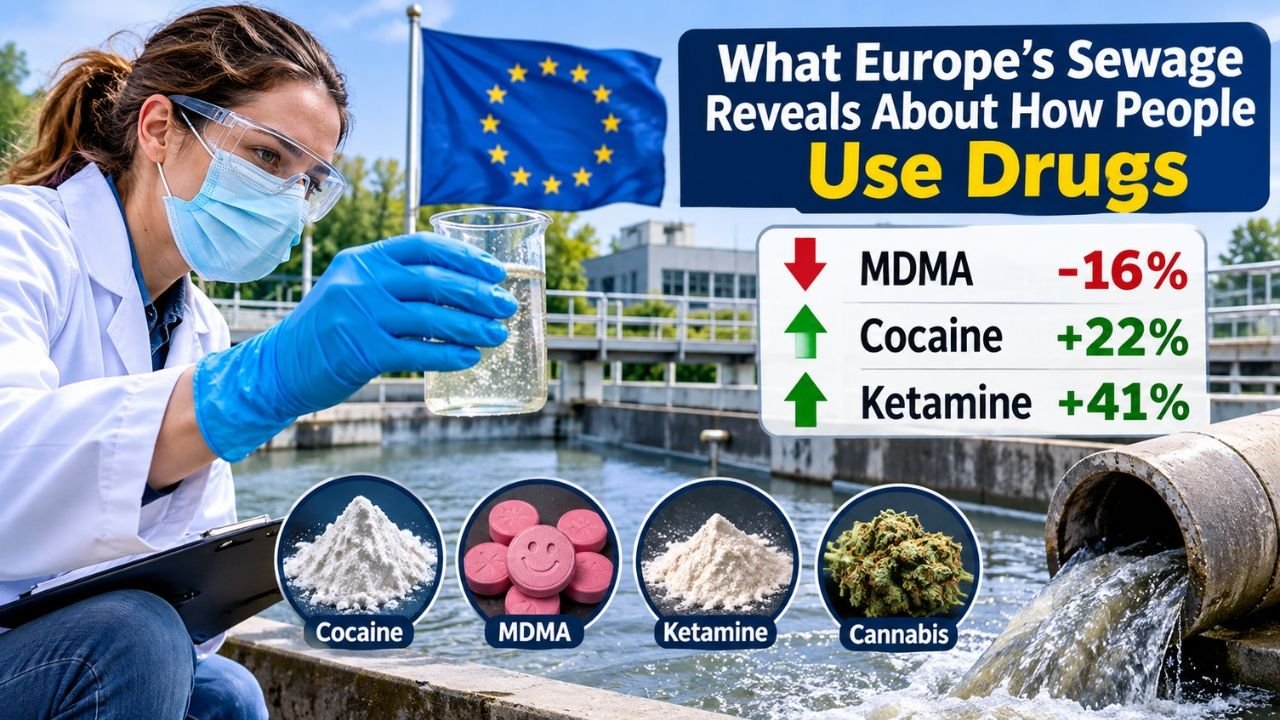
Surveys ask people what they use. Sewage simply records it. On March 18, 2026, the European Union Drugs Agency (EUDA) released the latest results of Europe’s largest wastewater drug monitoring project, and the headline was a surprise: MDMA residues fell sharply, while cocaine and ketamine rose.
The 2025 study covered 115 cities in 25 countries, 23 EU member states plus Norway and Türkiye, and analyzed wastewater from a population of about 72 million people, according to the EUDA’s news release. Unlike a survey, it does not depend on people reporting their own habits.
For readers outside Europe, including American families with relatives living or studying overseas, the findings offer a rare city-by-city view of what is actually being consumed, and useful context for families wondering when use has become a problem and whether support such as luxury rehab might help. It is also a useful case study in how public health researchers measure behavior that is hard to capture through self-reporting.
How Sewage Became a Drug Survey
The idea is straightforward. When people use drugs, their bodies break them down and excrete traces of the original substance or its metabolites. Those traces end up in the sewer system, and scientists can measure them at treatment plants before the water is cleaned.
According to the EUDA’s wastewater analysis page, raw 24-hour composite samples were collected during a single week between March and May 2025 in most participating cities. Labs tested for amphetamine, methamphetamine, ketamine and MDMA directly, and for metabolites of cocaine (benzoylecgonine) and cannabis (THC-COOH). Results are normalized per 1,000 people, which gives an estimate of the amount of each substance consumed per day per 1,000 inhabitants and allows cities of very different sizes to be compared.
The work is coordinated by the Sewage analysis CORe group Europe, known as SCORE, which was set up in 2010 to standardize methods across laboratories. The EUDA says the group has run annual monitoring campaigns since 2011.
The 2025 Results, Drug by Drug
The EUDA reported that all six drugs investigated were found in almost every participating city. The bigger story is how the levels shifted between 2024 and 2025 among cities with data for both years.
- Cocaine: Residues of the cocaine metabolite rose by about 22%, with the highest loads in Belgium, the Netherlands and Spain, and 48 of 85 comparable cities recorded an increase.
- Ketamine: Detections climbed by almost 41%, the largest rise of the year, with the highest loads in Belgium, Germany and the Netherlands.
- MDMA: Residues fell by almost 16%, and 48 of 78 comparable cities saw a decline, although Belgium, Spain, the Netherlands and Slovenia still had the highest loads.
- Cannabis: Euronews reported stable levels overall, with the highest loads in the Netherlands, Germany and Slovenia.
- Amphetamine: City-level results were mixed, with 36 of 82 cities recording an increase and 27 a decrease, and the highest loads were found in Norway, Sweden, Denmark, Belgium, the Netherlands and Germany.
- Methamphetamine: City-level results were mixed, with 37 of 80 cities recording an increase, and Euronews noted that use remains concentrated in the Czech Republic and Slovakia.
Taken together, the numbers suggest stimulant use in Europe is not shrinking so much as changing shape. A drop in one substance sat alongside clear increases in two others, which is the kind of shift that surveys, carried out less often, may be slower to show.
Why MDMA Fell and Ketamine Rose
Speaking to Euronews, João Matias, a scientific analyst on drug use at the EUDA, called the MDMA decline “the biggest surprise we have this year in Europe.” He linked it partly to younger people moving toward ketamine and synthetic cathinones. Euronews reported that the ketamine increase was tied to greater illicit availability and popularity among young people, and that Matias connected the cocaine rise to growing availability on the market.
Weekends Tell Their Own Story
Because samples are taken every day for a week, the data also shows when people use. According to the EUDA, more than 75% of cities had higher cocaine and MDMA loads from Friday to Monday than on weekdays. Almost half of cities showed the same weekend pattern for ketamine. Cannabis, amphetamine and methamphetamine were spread more evenly across the week.
That split points to two different kinds of use. Substances tied to nightlife cluster around weekends, while others appear more routine. Euronews also reported that differences between cities in the same country were partly explained by the presence of universities, nightlife districts and the age structure of the local population.
What Wastewater Cannot Tell Us
The EUDA is clear that this method has limits. Its analysis page states that wastewater monitoring “cannot provide information on prevalence and frequency of use, main classes of users and purity of the drugs.” In other words, a rise in cocaine residue could reflect more people using, the same people using more, or stronger product.
The agency lists other caveats as well. Heroin is difficult to track because its specific marker is unstable in wastewater, so researchers use morphine instead, which can also come from medical use. Population estimates for each sewer catchment can vary considerably, and in some cities the samples are not fully representative of the whole population. Turning total residues into doses is also complicated by different routes of use and changing purity.
That is why the EUDA treats wastewater as one source among several. Euronews, for example, cited national survey estimates that around 8.4% of European adults used cannabis in the past year, a type of figure sewage data cannot produce on its own.
A Method Spreading Beyond Europe
The EUDA release noted that nine countries outside the European study area were included for comparison: Brazil, Canada, Chile, Iceland, New Zealand, South Korea, Switzerland, the United Kingdom and the United States. That broader reach makes wastewater analysis a growing tool for comparing drug markets across borders.
For health officials, the appeal is speed. A single week of sampling can flag a rising substance, such as ketamine, while it is still emerging. For everyone else, the 2025 results are a reminder of how quickly the mix of drugs in a city can change from one year to the next.
Frequently Asked Questions (FAQs)
1. Can wastewater analysis identify individual drug users?
No. Samples are taken at treatment plants serving whole communities, and results are expressed as daily amounts per 1,000 inhabitants. The EUDA says the method cannot show how many people use a drug or how often.
2. Why did ketamine rise so sharply in 2025?
Ketamine detections rose by almost 41% across comparable cities. Euronews reported that the increase was linked to greater illicit availability and popularity among young people, with an EUDA analyst also pointing to a shift away from MDMA.
3. Was the United States part of the study?
The main European study covered 115 cities in 25 countries. According to the EUDA’s release, the United States was one of nine additional countries included for comparison, alongside countries such as Canada, Brazil and South Korea.
