
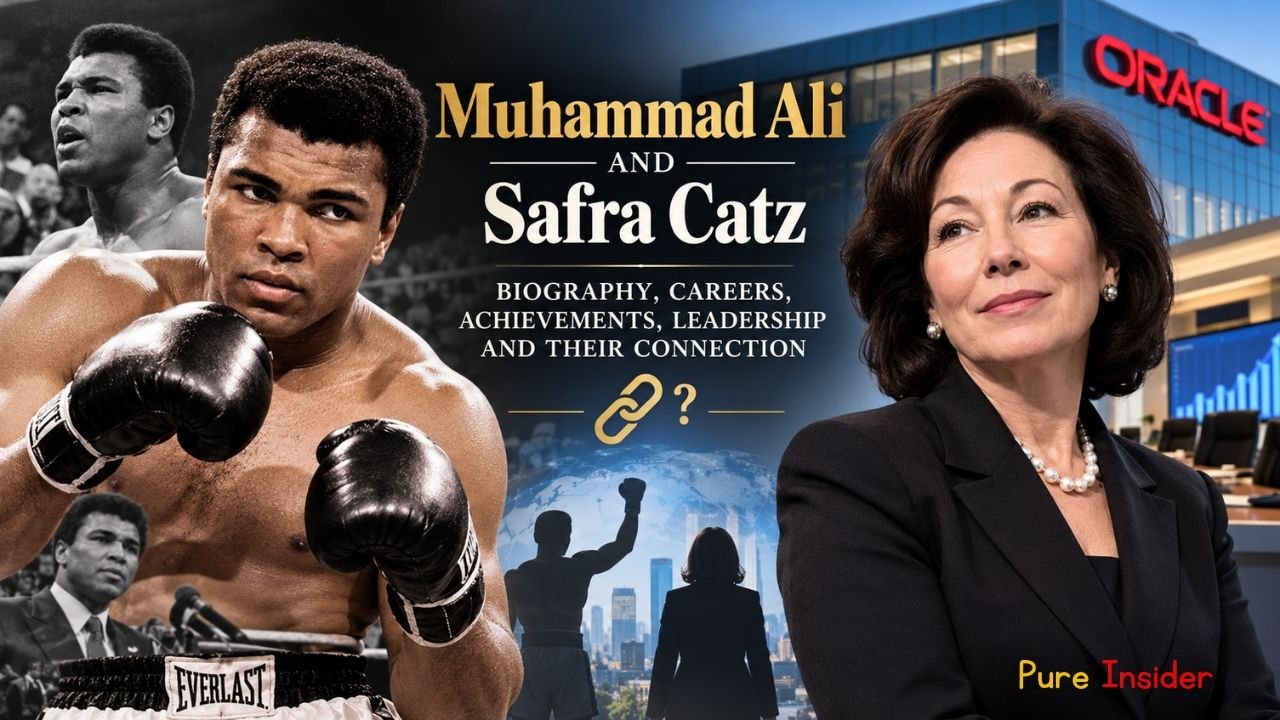
Muhammad Ali and Safra Catz are two internationally recognized personalities who achieved remarkable success in entirely different professional fields. Muhammad Ali was a legendary American heavyweight boxer, humanitarian, and civil rights advocate. Meanwhile, Safra Catz is a prominent American business executive and CEO of Oracle Corporation, one of the world’s largest technology companies.
Muhammad Ali and Safra Catz followed different career paths; their stories demonstrate the importance of determination, discipline, strategic thinking, and strong leadership. Ali became one of boxing’s greatest athletes through his extraordinary talent, confidence, and courage. Meanwhile, Catz became one of the most influential female executives in the technology industry through her financial expertise, business management, and corporate strategy.
Their achievements have attracted global attention, leading some readers to wonder whether these two prominent individuals share a personal, professional, or family relationship.
Despite their international recognition, no publicly verified evidence shows a direct relationship between Muhammad Ali and Safra Catz. Nevertheless, exploring their biographies, careers, accomplishments, financial success, and leadership approaches offers valuable insights into how individuals can build lasting influence across industries.
Who Are Muhammad Ali and Safra Catz?
Muhammad Ali was an American professional boxer born on January 17, 1942, in Louisville, Kentucky. Originally named Cassius Marcellus Clay Jr., he became famous for his exceptional boxing techniques, charismatic personality, and outspoken views on social justice. His successful career included three reigns as lineal heavyweight champion and numerous historic fights.
Beyond sports, Ali became a prominent humanitarian who supported civil rights, religious freedom, and international peace initiatives. His influence extended far beyond boxing, making him one of the twentieth century’s most recognizable personalities.
Safra Catz, on the other hand, is an Israeli-born American business executive born in Holon, Israel, in December 1961. She became widely recognized for her leadership at Oracle Corporation, where she held several senior executive roles before becoming chief executive officer in 2014.
After more than a decade as Oracle’s CEO, she transitioned to Executive Vice Chair of its Board of Directors in September 2025.
Although their professions differed, both built reputations for determination, strategic decision-making, and exceptional performance.
Muhammad Ali Early Life and Family Background
Muhammad Ali was born Cassius Marcellus Clay Jr. on January 17, 1942, in Louisville, Kentucky, United States. His father, Cassius Marcellus Clay Sr., worked as a sign painter, while his mother, Odessa Grady Clay, worked as a domestic employee.
Ali grew up during a period when racial segregation and discrimination were widespread in American society. These experiences shaped his understanding of social inequality and later led him to become involved in civil rights advocacy.
He became interested in boxing around age 12. After his bicycle was stolen, he encountered a police officer and boxing trainer, Joe Martin, who encouraged him to learn boxing.
This experience marked the beginning of an extraordinary athletic career.
Ali quickly demonstrated natural talent, exceptional speed, determination, and a willingness to train consistently. During his amateur boxing years, he competed in numerous tournaments and developed the skills that would eventually make him an international sporting sensation.
His early experiences also shaped his confident personality and strong commitment to his principles.
Muhammad Ali Professional Boxing Career
Muhammad Ali began attracting international attention after winning a gold medal in the light-heavyweight division at the 1960 Summer Olympics in Rome.
After his Olympic success, he turned professional and quickly became a promising heavyweight contender.
In February 1964, Ali achieved a breakthrough by defeating Sonny Liston to become world heavyweight champion. At just 22, he accomplished something many boxing experts considered unlikely.
His fighting style was unusual for a heavyweight boxer. Rather than relying exclusively on punching power, Ali combined fast footwork, quick reactions, defensive movement, and exceptional tactical intelligence.
His ability to anticipate opponents’ movements and adapt during matches set him apart from other boxers.
Throughout his professional career, Ali participated in several legendary boxing contests, including the Fight of the Century against Joe Frazier in 1971, the Rumble in the Jungle against George Foreman in 1974, and the Thrilla in Manila against Frazier in 1975.
These contests became defining moments in international sporting history.
Ali finished his professional boxing career with an impressive record of 56 wins and five losses, including 37 knockouts.
His accomplishments helped establish his reputation as one of the greatest heavyweight boxers of all time.
Muhammad Ali Major Achievements and Awards
Muhammad Ali earned numerous achievements throughout his sporting career and humanitarian activities.
His most significant accomplishments include winning an Olympic gold medal in 1960, becoming heavyweight world champion in 1964, regaining the heavyweight championship in 1974, and winning another heavyweight title in 1978.
He also became famous for his outstanding performances against some of boxing’s most respected competitors.
Beyond professional competition, Ali received major recognition for his contributions to society.
In 2005, President George W. Bush awarded him the Presidential Medal of Freedom, one of the United States’ highest civilian honors.
His influence reached millions of people through his advocacy for racial equality, religious freedom, humanitarian assistance, and peaceful international relations.
Today, Ali remains an enduring symbol of courage, confidence, and personal conviction.
Muhammad Ali Personal Life and Humanitarian Work
Muhammad Ali’s personal life was closely connected to his religious beliefs, family relationships, and humanitarian commitments.
After embracing Islam during the 1960s, he changed his name from Cassius Clay to Muhammad Ali. His religious identity became central to his public persona and personal philosophy.
One of the most controversial moments in his career occurred in 1967 when he refused induction into the United States military during the Vietnam War.
His decision led to legal trouble, the loss of his boxing license, and a pause in his professional career. In 1971, the United States Supreme Court unanimously overturned his conviction.
Although the controversy affected his career, it also strengthened his reputation among many supporters as someone willing to defend his principles.
Outside boxing, Ali participated in charitable initiatives and humanitarian activities worldwide.
He was diagnosed with Parkinson’s disease in the 1980s and later became a highly visible figure associated with awareness of the condition.
Muhammad Ali died on June 3, 2016, at the age of 74, leaving behind an extraordinary sporting and humanitarian legacy.
Safra Catz Early Life and Education
Safra Ada Catz was born in Holon, Israel, in December 1961. She moved to the United States with her family as a child and grew up in Massachusetts.
Her early life emphasized education, academic achievement, and professional development.
Catz attended Brookline High School before continuing her education at the University of Pennsylvania.
In 1983, she graduated from the Wharton School of the University of Pennsylvania with a bachelor’s degree. She subsequently earned a Juris Doctor degree from the University of Pennsylvania Law School in 1986.
Her academic background provided a strong foundation in business principles, financial analysis, corporate management, and legal reasoning.
Although she studied law, Catz ultimately chose a career in investment banking.
This decision became a significant turning point in her professional journey.
Her combination of financial expertise, legal education, and analytical skills later proved valuable in managing complex corporate transactions and business operations.
Safra Catz Early Professional Career
Before becoming a major figure in the technology industry, Safra Catz developed extensive experience in investment banking.
She worked at Donaldson, Lufkin & Jenrette, a prominent American investment banking firm.
During her time there, she developed expertise in corporate finance, mergers, acquisitions, financial restructuring, and strategic business transactions.
As she gained experience, her responsibilities grew, eventually leading to senior leadership roles.
She became a senior vice president in the 1990s and later served as a managing director.
These roles let her participate in complex financial negotiations and build professional relationships with major corporations.
Her investment banking background gave her valuable insight into how large organizations operate, manage capital, and evaluate business opportunities.
This experience ultimately prepared her to lead at Oracle Corporation.
Safra Catz Career at Oracle Corporation
Safra Catz joined Oracle Corporation in 1999, beginning a long association with one of the world’s leading enterprise technology companies.
She quickly became an important member of Oracle’s senior leadership team.
Over the following years, Catz held several influential positions, including senior vice president, executive vice president, president, chief financial officer, and chief executive officer.
In September 2014, Oracle announced that Larry Ellison would step down as CEO, with Safra Catz and Mark Hurd becoming co-chief executive officers.
After Hurd’s departure and death in 2019, Catz remained Oracle’s sole CEO.
During her leadership, Oracle expanded its enterprise technology operations and invested heavily in cloud computing, software services, and corporate acquisitions.
She became particularly recognized for financial discipline, operational efficiency, and her involvement in the company’s acquisition strategy.
Major acquisitions during her career at Oracle included PeopleSoft, Soft, Sun Microsystems, and Cerner.
These transactions helped Oracle expand its presence across enterprise software, technology infrastructure, and healthcare information systems.
On September 22, 2025, Oracle announced that Catz would become Executive Vice Chair of its Board of Directors, while Clay Magouyrk and Mike Sicilia would assume the roles of co-CEOs.
As of 2026, she continues to influence Oracle’s strategic direction through her board leadership position.
Safra Catz Business Leadership and Achievements
Safra Catz has built a reputation as a disciplined, strategic corporate leader.
Her approach to business management emphasizes financial performance, operational effectiveness, careful planning, and long-term corporate growth.
Throughout her career, she has played an important role in Oracle’s business strategy and corporate development.
One of her most significant professional accomplishments has been helping Oracle manage numerous acquisitions and integrate acquired companies into its larger business structure.
Successful corporate acquisitions require financial analysis, strategic evaluation, negotiation skills, and organizational coordination.
Catz’s investment banking background made her particularly well suited to these responsibilities.
She has also received recognition from major business publications for her position among influential women in corporate leadership.
Her career shows how financial expertise and strategic decision-making can drive leadership success in a competitive global industry.
Muhammad Ali and Safra Catz: Are They Related?
One question surrounding the keyword Muhammad Ali and Safra Catz is whether these two prominent personalities share a personal or professional connection.
Based on available public biographical information, no verified evidence shows that Muhammad Ali and Safra Catz were related, collaborated professionally, or maintained a documented personal relationship.
Ali spent most of his professional career in boxing, sports entertainment, and humanitarian advocacy.
Catz developed her career in investment banking, corporate finance, and enterprise technology management.
Their backgrounds, professional responsibilities, and public activities differed significantly.
Although they were both internationally recognized figures, recognition alone does not establish a meaningful personal relationship.
Therefore, the connection between Muhammad Ali and Safra Catz is best understood as a comparison of two successful individuals from separate professional fields rather than evidence of a documented partnership.
Muhammad Ali and Safra Catz: Net Worth and Financial Success
Muhammad Ali and Safra Catz achieved financial success through different professional activities.
Ali earned substantial income from championship boxing matches, commercial endorsements, licensing agreements, and public appearances.
His international popularity also created opportunities beyond competitive sports.
However, published estimates of his net worth at the time of his death vary, and without authoritative financial documentation, an exact estate valuation should not be treated as confirmed.
Safra Catz accumulated significant wealth through executive compensation, Oracle stock ownership, and long-term equity awards.
According to Forbes’ real-time billionaire tracking, her estimated net worth was approximately $2.9 billion on October 15, 2026. This figure is an estimate, not a fixed amount, and can fluctuate with share prices and other financial factors.
Their financial achievements reflect different paths to wealth.
Ali generated income primarily through athletic performance, celebrity recognition, and commercial opportunities, while Catz built her fortune through corporate leadership, executive compensation, and investments.
Muhammad Ali and Safra Catz: Leadership Style Comparison
Despite their different professions, Muhammad Ali and Safra Catz demonstrated several leadership qualities that contributed to their success.
Ali’s leadership style was characterized by charisma, confidence, courage, and the ability to motivate others.
He used his public platform to communicate messages about personal identity, social justice, and individual freedom.
His willingness to challenge established expectations made him an influential cultural personality.
Catz, meanwhile, developed a leadership approach centered on strategic planning, financial accountability, and operational discipline.
Rather than relying on public charisma, her professional influence emerged through corporate decision-making, business performance, and long-term organizational development.
Both demonstrated the importance of preparation and adaptability.
Ali adjusted his boxing techniques to overcome powerful opponents, while Catz helped Oracle respond to changes in enterprise technology and competitive business markets.
Their different approaches illustrate that successful leadership can take many forms.
Similarities Between Muhammad Ali and Safra Catz
Although Muhammad Ali and Safra Catz worked in unrelated industries, several broad similarities can be identified in their professional journeys.
Determination and persistence: Both faced demanding professional environments and showed the commitment needed to succeed.
Strategic thinking: Ali used tactical intelligence inside the boxing ring, while Catz applied financial analysis and business strategy to corporate leadership.
International recognition: Ali became a global sporting icon, while Catz earned international recognition as a technology executive.
Professional discipline: Both relied on preparation, consistency, and long-term dedication throughout their careers.
Influence beyond their original roles: Ali became known for humanitarian advocacy, while Catz’s influence extended from finance into technology leadership, corporate governance, and business education.
These similarities offer valuable lessons about how individuals can achieve excellence through different professional paths.
Differences Between Muhammad Ali and Safra Catz
The most obvious difference between Muhammad Ali and Safra Catz is their professional background.
Ali was an athlete whose achievements depended on physical conditioning, boxing skills, competitive performance, and public appeal.
Catz is a business executive whose accomplishments stem from financial expertise, management experience, negotiation skills, and corporate leadership.
Ali became famous during the 1960s and remained a global cultural icon for decades.
Catz joined Oracle’s executive leadership in 1999 and became particularly prominent as the company’s CEO in the 21st century.
Their public communication styles also differed.
Ali was famous for outspoken interviews, memorable statements, and a charismatic personality.
Catz generally became known for business-focused communication and financial decision-making.
Despite these differences, both demonstrated that professional success requires developing specialized abilities and applying them consistently.
Global Influence and Lasting Legacy
Muhammad Ali’s legacy extends beyond his boxing achievements.
He helped transform public expectations of athletes by showing that sporting figures could join important conversations about society, equality, religion, and international affairs.
His career inspired generations of boxers and individuals seeking confidence, courage, and personal independence.
The Muhammad Ali Center in Louisville continues to preserve his legacy and promote educational and humanitarian initiatives.
Safra Catz’s professional legacy is connected to her extensive leadership at Oracle and her contributions to corporate management.
Her work in acquisitions, finance, and strategy helped shape Oracle’s growth into a major global enterprise technology provider.
She also exemplifies female leadership in an industry where senior executive positions have historically been dominated by men.
While their contributions cannot be measured using the same standards, both have established significant reputations within their respective fields.
Frequently Asked Questions About Muhammad Ali and Safra Catz
Who was Muhammad Ali?
Muhammad Ali was an American professional boxer, Olympic gold medalist, three-time lineal heavyweight champion, and humanitarian. He was born in 1942 and died in 2016.
Who is Safra Catz?
Safra Catz is an Israeli-born American business executive best known for leading Oracle Corporation. She served as Oracle’s CEO from 2014 to 2025 and became Executive Vice Chair of the Board in September 2025.
Are Muhammad Ali and Safra Catz related?
No publicly verified evidence shows that Muhammad Ali and Safra Catz share a family relationship or direct professional connection.
What was Muhammad Ali famous for?
Muhammad Ali became famous for his exceptional heavyweight boxing career, Olympic gold medal, legendary championship fights, outspoken personality, and humanitarian advocacy.
What is Safra Catz famous for?
Safra Catz is known for her executive leadership at Oracle, corporate finance expertise, involvement in major acquisitions, and contributions to enterprise technology strategy.
Conclusion
Muhammad Ali and Safra Catz are two influential figures whose achievements show different paths to professional success and international recognition. Muhammad Ali became a legendary heavyweight boxer, cultural figure, and humanitarian through extraordinary athletic ability, determination, and courage. Safra Catz became a respected business executive through financial expertise, strategic leadership, and decades of experience at Oracle Corporation.
Although no verified public evidence shows a direct personal, family, or business connection between them, comparing their lives reveals important lessons about leadership, perseverance, and long-term achievement.
Ali’s legacy continues to inspire athletes and social justice advocates, while Catz’s professional accomplishments offer an example of strategic leadership in the global technology industry.
The stories of Muhammad Ali and Safra Catz demonstrate that success can emerge from very different backgrounds and careers. Their achievements highlight how determination, preparation, adaptability, and commitment to personal goals can create influence that extends far beyond an individual’s original profession.
You May Also Read: Nelson Peltz and Amancio Ortega: Biography, Business Careers, Achievements and Global Influence
