
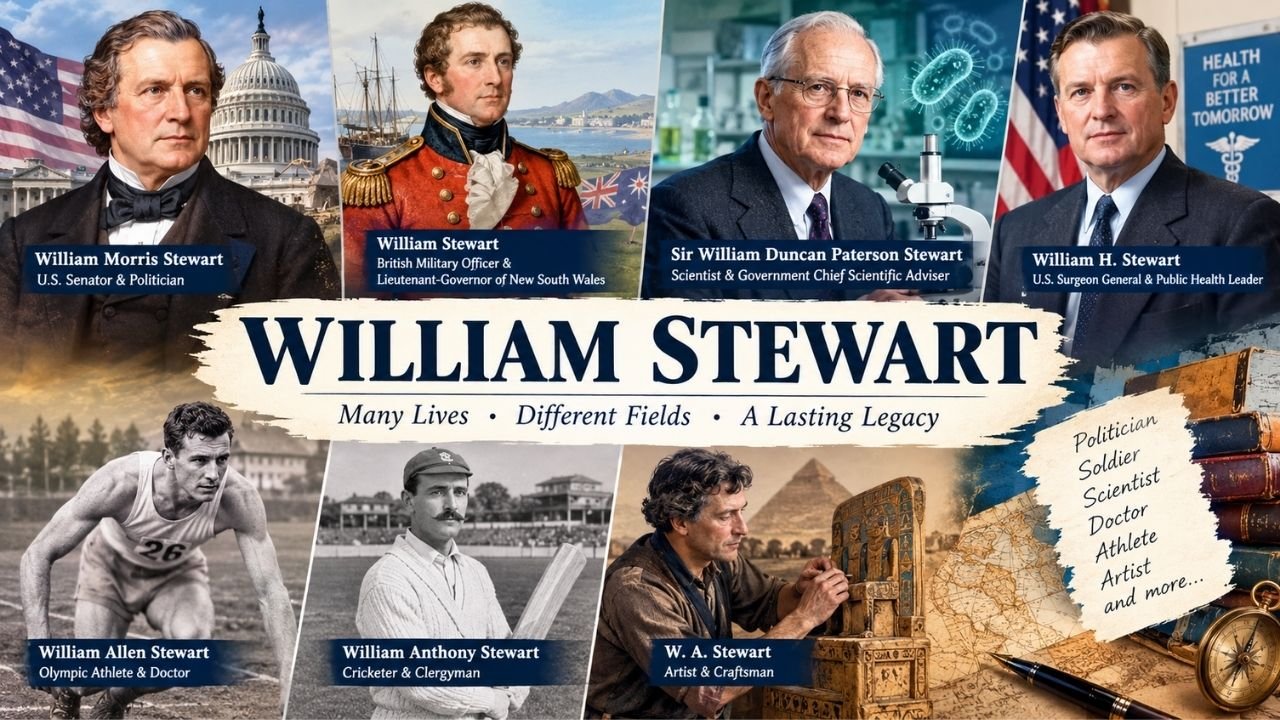
Who Is William Stewart?
The name William Stewart is associated with several notable individuals from different periods and fields of history. It is therefore important to understand that William Stewart does not refer to just one universally recognized person. People with this name have made contributions to politics, military service, science, medicine, sport, literature, and public life.
Among the most historically significant figures is William Morris Stewart, an American lawyer and politician who served as a United States senator from Nevada for more than two decades. Another prominent figure is Sir William Duncan Paterson Stewart, a Scottish scientist recognized for his work in microbiology and biological nitrogen fixation. There was also a British military officer named William Stewart who became lieutenant-governor of New South Wales in the nineteenth century.
Because of this diversity, researching William Stewart requires attention to dates, occupations, countries, and achievements. This article explores several of the best-documented figures who bore the name and explains why it continues to appear in historical and biographical records.
William Stewart and the Importance of the Name
William is one of the most common traditional English and Scottish first names, while Stewart is a historic Scottish surname. As a result, many people throughout history have been named William Stewart.
Historical records contain William Stewarts connected with Scotland, England, Ireland, Australia, Canada, and the United States. Some were politicians and military officers, while others became scientists, athletes, doctors, artists, and religious figures.
For anyone searching for a biography of William Stewart, it is particularly important to identify the correct individual. A biography of the American senator, for example, is completely different from the life story of the Scottish scientist or British soldier.
William Morris Stewart: The American Politician
One of the most prominent people associated with the name was William Morris Stewart, an American lawyer and politician who represented Nevada in the United States Senate.
Stewart was born on August 9, 1827, in Galen, Wayne County, New York. He later moved west during the California Gold Rush and became involved in mining and the law. According to the Biographical Directory of the United States Congress, he studied law, was admitted to the bar in 1852, and began practicing in Nevada City, California.
His career eventually took him to Nevada, where he became involved in mining litigation and the development of the Comstock Lode. His legal and political influence grew alongside Nevada’s emergence as a state.
William Morris Stewart and Nevada Politics
William Morris Stewart played an important role in Nevada’s early political history. He participated in the state’s constitutional convention in 1863 and was elected to the United States Senate when Nevada entered the Union.
He took his Senate seat on February 1, 1865. His first period of Senate service lasted until March 3, 1875. After returning to private legal practice, Stewart returned to the Senate in 1887 and remained there until 1905.
The United States Senate describes him as the “silver senator” because of his strong association with the Western mining industry and the political movement supporting silver.
His political career was closely connected to issues such as mining, railroads, irrigation, western development, and land policy.
William Morris Stewart and the Fifteenth Amendment
One of the most important aspects of William Morris Stewart’s political legacy was his involvement with the Fifteenth Amendment to the United States Constitution.
The U.S. Senate identifies Stewart as a key figure in drafting the final version of the amendment. The amendment addressed voting rights and prohibited denying the right to vote on the basis of race, color, or previous condition of servitude.
This work placed Stewart among the politicians involved in one of the most important constitutional developments of the Reconstruction era.
His political career also included a notable connection with the famous American writer Mark Twain. According to the U.S. Senate, Stewart employed Twain as a personal secretary during his career.
William Morris Stewart and the Silver Movement
Stewart’s political views changed over the course of his career. During the 1890s, he became associated with the Silver Party because of his opposition to the Republican position on demonetizing silver.
His support for free silver reflected the economic concerns of Western mining states. Silver production was central to Nevada’s economy, and monetary policy therefore had major consequences for miners, businesses, and communities.
Stewart eventually returned to the Republican caucus in 1899. His career illustrates how economic interests, regional politics, and national debates were intertwined in nineteenth-century American politics.
William Stewart as a British Military Officer
Another important historical figure, William Stewart, was a British soldier who lived from 1769 to 1854.
According to the Australian Dictionary of Biography, this William Stewart was born in Caithness, Scotland, and joined the British Army in the 1790s. He served in several military campaigns, including operations in the West Indies and the Peninsular War. He was wounded during fighting in Portugal and rose to the rank of lieutenant-colonel.
His military career eventually brought him to Australia.
In 1825, Stewart arrived in New South Wales with the 3rd Regiment. He subsequently served as lieutenant-governor of New South Wales and briefly acted as governor during the transition between administrations.
William Stewart and New South Wales
William Stewart’s Australian career is an important part of colonial history.
The Australian Dictionary of Biography records him as lieutenant-governor from 1825 to 1827 and identifies him as having served briefly as governor in 1825. He later became a landowner in New South Wales.
His life demonstrates how British military officers frequently moved between military and administrative roles during the expansion of the British Empire.
Stewart died on April 8, 1854, in New South Wales at approximately 85 years of age.
Sir William Stewart: The Scottish Scientist
Another highly distinguished figure was Sir William Duncan Paterson Stewart, born in 1935.
Unlike the nineteenth-century soldier and politician, this William Stewart became known for science. He was a Scottish biologist whose research focused particularly on microbiology and biological nitrogen fixation.
Stewart was educated in Scotland and studied at the University of Glasgow, where he earned bachelor’s, doctoral, and higher scientific degrees. His doctoral research focused on biological nitrogen fixation.
His scientific career eventually expanded beyond academic research into public service and national science policy.
William Stewart and Biological Nitrogen Fixation
Biological nitrogen fixation is an important scientific process in which microorganisms convert atmospheric nitrogen into forms usable by living organisms.
Stewart’s research in this area contributed to the broader understanding of microorganisms, agriculture, and nitrogen-related biological processes.
His career illustrates how microbiological research can have applications beyond the laboratory, particularly in agriculture and environmental science.
He later became associated with major scientific organizations and served in senior advisory positions.
William Stewart as Government Chief Scientific Adviser
Sir William Stewart became particularly prominent when he served as the United Kingdom’s Government Chief Scientific Adviser.
His career combined scientific research with government-level scientific policy. This position placed him in a role where scientific knowledge could inform national decisions and public policy.
He also served as President of the Royal Society of Edinburgh from 1999 to 2002 and was associated with the Microbiological Research Authority.
His scientific accomplishments were recognized through major honors, including a knighthood and fellowship of the Royal Society.
William H. Stewart and American Public Health
Another important person associated with the broader William Stewart keyword is William H. Stewart, an American physician and public health leader.
The National Heart, Lung, and Blood Institute records that Dr. William Stewart served briefly as director of the National Heart Institute in 1965 before becoming U.S. Surgeon General. He served as Surgeon General from 1965 to 1969.
His career was particularly significant in the history of public health.
He became the first U.S. Surgeon General to require health warnings on cigarette packages. He also oversaw changes within the U.S. Public Health Service and later returned to academic and administrative work in Louisiana.
This makes William H. Stewart another important figure who may appear in searches for the keyword William Stewart.
William Stewart in Athletics
The name William Stewart also appears in Olympic sporting history.
William Allen Stewart was an Australian sprinter who competed for Australasia at the 1912 Olympic Games in Stockholm. Olympedia records that he was born on October 22, 1889, in Launceston, Tasmania.
Stewart competed in the men’s 100-meter and 200-meter events.
Before and during his sporting career, he was also studying medicine. After World War I, he returned to Australia and developed a long medical career. His life therefore combined athletics, medicine, and military service.
He later left his estate to the University of Melbourne to establish scholarships, adding a philanthropic dimension to his legacy.
William Stewart in Cricket
Another William Stewart was an English first-class cricketer and clergyman.
William Anthony Stewart was born on May 19, 1847, in Sparsholt, Hampshire. He played first-class cricket for Oxford University and Hampshire during the nineteenth century.
Records identify him as a right-handed batsman and wicket-keeper. He appeared in nine first-class matches, scoring 46 runs and recording 15 catches and nine stumpings.
Although his cricket career was relatively brief, his inclusion in historical sporting records demonstrates the wide range of professions associated with the name William Stewart.
William Stewart as an Artist and Craftsman
William Arnold Stewart, commonly known as W. A. Stewart, was another notable person with this name.
Born in Ilkley, Yorkshire, in 1882, he became an artist and craftsman. He studied at the Royal College of Art and became particularly known for his work reconstructing ancient furniture discovered in the tomb of Queen Hetepheres near the Giza Pyramids.
His work required both artistic ability and technical craftsmanship. Reconstructing ancient objects from fragments demanded careful observation and knowledge of historical construction methods.
Stewart’s artistic work was displayed at several galleries and institutions, and he also contributed to industrial development in Palestine during the period leading up to the Second World War.
Why There Are So Many William Stewart Biographies
A major reason the keyword William Stewart can be difficult to research is the historical popularity of both names.
“William” has been used extensively across Britain and other English-speaking countries for centuries. “Stewart” is an old Scottish surname with strong historical connections to Scotland’s royal and political traditions.
Consequently, numerous unrelated people have shared the exact name.
For modern readers, dates and occupations are therefore essential when identifying a particular William Stewart. A person researching the politician William Morris Stewart should not confuse him with the scientist Sir William Stewart or the British military officer William Stewart.
William Stewart Family and Personal Life
Because several different people share the name, there is no single answer to questions such as “Who was William Stewart’s wife?” or “Where did William Stewart live?”
For example, William Morris Stewart had a family background connected to New York and later Nevada. At the same time, the British military officer William Stewart was born in Scotland and eventually settled in Australia. Sir William Stewart was a twentieth-century Scottish scientist with an entirely different family and professional history.
Therefore, searches for the William Stewart family, William Stewart wife, or William Stewart children should always specify the individual being researched.
This distinction is especially important for SEO content because combining unrelated personal details can create inaccurate biographical information.
William Stewart’s Historical Legacy
The combined historical record associated with the name William Stewart is remarkably diverse.
William Morris Stewart left a major political legacy through his long service in the U.S. Senate and his involvement in the development of the West. His work on the Fifteenth Amendment remains one of the most important parts of his political history.
The British military officer William Stewart is remembered in Australian colonial history for his military and administrative service.
Sir William Stewart contributed to microbiology and British science policy, while William H. Stewart played an important role in American public health.
Other William Stewarts contributed to athletics, cricket, art, and other fields.
Frequently Asked Questions About William Stewart
Who was William Stewart?
William Stewart is a name shared by numerous historical figures. Notable individuals include William Morris Stewart, a U.S. senator from Nevada; a British military officer who became lieutenant-governor of New South Wales; Sir William Stewart, a Scottish scientist; and William H. Stewart, a former U.S. Surgeon General.
Was William Stewart a politician?
Yes. William Morris Stewart was a major American politician who served as a U.S. senator from Nevada from 1865 to 1875 and again from 1887 to 1905.
What was William Morris Stewart famous for?
William Morris Stewart was known for his long political career in Nevada, his involvement in mining and western development, his role in drafting the Fifteenth Amendment, and his support for silver-related economic policies.
Was there a William Stewart who served in Australia?
Yes. William Stewart, a British military officer born in 1769, became lieutenant-governor of New South Wales and briefly served as governor in 1825.
Who was Sir William Stewart?
Sir William Duncan Paterson Stewart was a Scottish biologist born in 1935. He was known for research into biological nitrogen fixation and later became the United Kingdom’s Government Chief Scientific Adviser.
Conclusion
William Stewart represents a fascinating collection of historical biographies rather than one single individual. People with this name have appeared in politics, military history, science, medicine, athletics, cricket, art, and public administration.
You May Also Read: William Douglas Sewell: Biography, Family, Early Life and Career
