
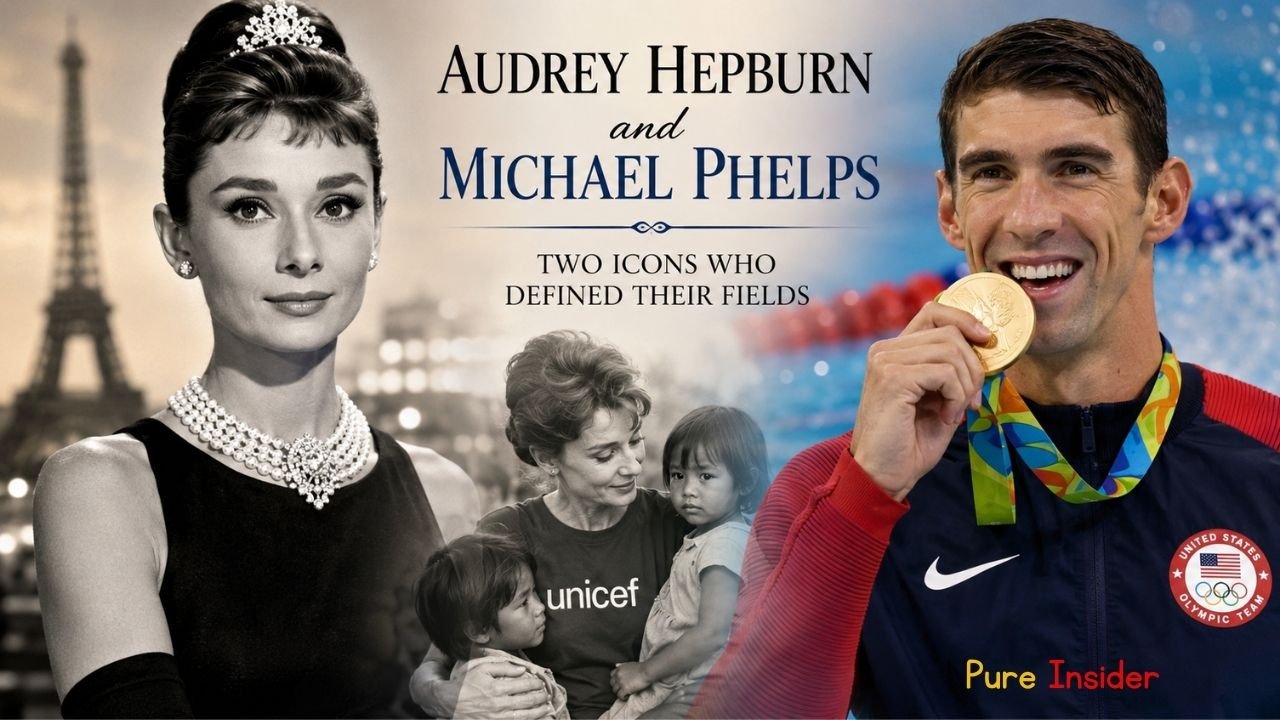
Audrey Hepburn and Michael Phelps, they may initially wonder what connects a legendary Hollywood actress with one of the greatest swimmers in Olympic history. Audrey Hepburn and Michael Phelps came from completely different generations and pursued very different careers. Hepburn became an international film star, fashion icon, and humanitarian, while Phelps established himself as a record-breaking competitive swimmer.
Although there is no well-documented personal or professional relationship between the two, their stories offer an interesting comparison. Both became globally recognized names, both reached extraordinary levels of success, and both developed legacies that extended beyond their original professions. Hepburn used her fame to advocate for children around the world, while Phelps became an influential figure in sports and has spoken publicly about mental health and personal challenges.
Understanding Audrey Hepburn and Michael Phelps therefore means looking beyond their professions and examining the qualities that made each person an enduring cultural icon.
Who Was Audrey Hepburn?
Audrey Hepburn was born on May 4, 1929, in Brussels, Belgium. She became one of the most admired actresses of the 20th century and remains one of the most recognizable figures in cinema history.
Her childhood was shaped by the difficulties of World War II and the German occupation of the Netherlands. Those experiences later influenced her humanitarian outlook. UNICEF notes that Hepburn herself recalled receiving food and medical assistance after the war, which created a lasting connection with the organization she would eventually serve as a Goodwill Ambassador.
Before becoming an international movie star, Hepburn studied ballet and worked toward becoming a dancer. Her path eventually shifted toward acting, and she began appearing in films and stage productions.
Her breakthrough came with Roman Holiday, in which she starred opposite Gregory Peck. The film transformed her into an international star and secured her an Academy Award for Best Actress.
Audrey Hepburn’s Hollywood Career
Hepburn’s acting career became one of the defining stories of Hollywood’s Golden Age. Her screen presence was different from the conventional image of many major stars of the era. She was celebrated for her elegance, expressive acting, distinctive style, and understated personality.
Among her best-known films are Roman Holiday, Sabrina, Funny Face, Breakfast at Tiffany’s, Charade, and My Fair Lady.
Her role as Holly Golightly in Breakfast at Tiffany’s became especially influential. The character and Hepburn’s fashion were widely associated with sophistication and timeless style.
She continued to work in cinema throughout the following decades, although she gradually reduced her acting commitments. By the later part of her life, humanitarian work had become increasingly important to her.
Her final screen appearance was in Steven Spielberg’s Always in 1989, according to biographical records.
Audrey Hepburn’s Humanitarian Legacy
One of the most important aspects of Hepburn’s life was her work with UNICEF.
She became a UNICEF Goodwill Ambassador in the late 1980s and traveled extensively to highlight the needs of children affected by poverty, hunger, conflict, and inadequate access to basic services.
UNICEF records that she visited projects and communities in countries including Ethiopia, Turkey, Venezuela, Ecuador, Guatemala, Honduras, Bangladesh, Thailand, Vietnam, and Sudan. She also used her celebrity status to speak publicly about children’s welfare and encourage support for humanitarian programs.
This part of her life is particularly important when discussing her legacy. Hepburn was not remembered solely for her films. She transformed her international fame into a platform for humanitarian advocacy.
She received the Presidential Medal of Freedom in 1992, one of the highest civilian honors in the United States. UNICEF also records that she continued her humanitarian activities even while seriously ill. She died in Switzerland on January 20, 1993.
Who Is Michael Phelps?
Michael Phelps represents a completely different form of achievement.
Born on June 30, 1985, in Baltimore, Maryland, Phelps became a competitive swimmer at a young age and eventually rose to the highest level of international sport.
His Olympic career began at the 2000 Sydney Games when he was only 15 years old. He subsequently competed at Athens 2004, Beijing 2008, London 2012, and Rio 2016.
According to the U.S. Olympic & Paralympic Committee, Phelps finished his Olympic career with 28 medals, including 23 gold medals, making him the most decorated Olympian of all time.
His achievements made him one of the most recognizable athletes in modern sports history.
Michael Phelps and Olympic History
Phelps’ Olympic career is remarkable for both its longevity and its extraordinary medal haul.
He was awarded six gold medals and two bronze medals at the 2004 Summer Olympics in Athens. Four years later in Beijing, he achieved one of the most celebrated performances in Olympic history by winning eight gold medals.
His Beijing performance established a new Olympic record for gold medals won by an individual athlete at a single Games.
Phelps continued competing at the highest level at the 2012 London Olympics and returned for his fifth Olympic Games at the 2016 Rio Olympics. The USOPC notes that he became the first American male swimmer to compete in five Olympic Games.
His final Olympic appearance in Rio ended with additional medals, cementing his position as one of the most successful athletes in Olympic history.
Audrey Hepburn and Michael Phelps: Different Paths to Global Fame
The most interesting aspect of Audrey Hepburn and Michael Phelps is the contrast between their careers.
Hepburn achieved international recognition through film, fashion, and humanitarian work. Phelps achieved his fame through swimming and international competition.
Their professions required very different abilities. Hepburn relied on acting, emotional expression, timing, presence, and communication. Phelps relied on physical conditioning, technical skill, endurance, discipline, and competitive preparation.
Yet both careers demonstrate the importance of consistency.
Hepburn did not become an icon through a single performance. Her reputation developed across decades of films and public appearances before evolving into a humanitarian legacy.
Similarly, Phelps did not build his reputation on a single Olympic race. His status came from years of training and repeated performances on the world’s biggest sporting stage.
A Comparison of Their Achievements
A simple comparison highlights how different their accomplishments were:
| Category | Audrey Hepburn | Michael Phelps |
|---|
| Birth year | 1929 | 1985 |
| Main profession | Actress and humanitarian | Competitive swimmer |
| Primary field | Cinema and humanitarian advocacy | Olympic sport |
| Major breakthrough | Roman Holiday | International swimming and Olympic competition |
| Signature achievement | Acclaimed film career and humanitarian service | 28 Olympic medals, including 23 gold |
| Global influence | Film, fashion, humanitarianism | Swimming, Olympic sport, athletic culture |
| Major humanitarian association | UNICEF | Advocacy and charitable initiatives |
| Era of greatest fame | Mid-20th century onward | 2000s–2010s |
The comparison also makes clear that the two belonged to different generations. Hepburn died in 1993, when Phelps was only eight years old. Consequently, claims suggesting that the two had a significant personal relationship should be treated cautiously unless supported by reliable evidence.
Did Audrey Hepburn and Michael Phelps Ever Work Together?
There is no widely documented evidence of a notable professional collaboration or personal relationship between Audrey Hepburn and Michael Phelps.
The timeline alone makes their connection unlikely. Hepburn’s most influential period in Hollywood occurred decades before Phelps became an international athlete.
Hepburn’s later years were primarily associated with family life, humanitarian work, and UNICEF. Phelps was still a child during the final years of her life.
Therefore, an article about Audrey Hepburn and Michael Phelps should not present them as collaborators, friends, relatives, or romantic partners without credible evidence.
Instead, the keyword is more appropriately understood as a comparison between two globally recognized figures whose accomplishments came from entirely different fields.
What Audrey Hepburn and Michael Phelps Have in Common
Despite their differences, several themes connect their stories.
Extraordinary Dedication
Both Hepburn and Phelps demonstrated significant dedication to their chosen fields.
Hepburn trained in ballet before transitioning into acting and spent years developing her craft. Phelps spent countless hours training in the pool to reach an elite level.
Their achievements illustrate that exceptional performance usually requires years of preparation.
Global Recognition
Both became internationally recognizable names.
Hepburn’s films reached audiences around the world, while Phelps’ Olympic performances were watched by millions of sports fans internationally.
Their names became larger than their professions. “Audrey Hepburn” became associated with classic cinema and elegance, while “Michael Phelps” became synonymous with Olympic swimming excellence.
Influence Beyond Their Careers
Neither person’s influence ended with professional success.
Hepburn became a major humanitarian advocate through UNICEF. Her celebrity helped draw public attention to children’s issues around the world.
Phelps has also used his public platform to discuss issues beyond competitive swimming, including mental health and the pressures associated with elite athletic performance.
This broader influence is an important part of why both remain culturally relevant.
The Importance of Resilience
Resilience is another theme found in both biographies.
Hepburn experienced severe hardship during her childhood in wartime Europe. Her later humanitarian work was influenced in part by her understanding of hunger and suffering.
Phelps faced the intense pressures associated with elite competition and public life. His career also included setbacks and personal difficulties, yet he repeatedly returned to competition and continued achieving at the highest level.
Their experiences demonstrate that public success does not mean a person has an uncomplicated life.
Their Lasting Cultural Influence
Audrey Hepburn’s cultural influence remains particularly strong in fashion and film. Decades after her death, her image continues to appear in discussions of classic Hollywood style.
Her humanitarian legacy is equally important. UNICEF continues to recognize her contributions and her commitment to children.
Michael Phelps has similarly left an extraordinary mark on swimming. His Olympic medal record has made him a benchmark against which future swimmers are measured.
His success also helped draw greater attention to competitive swimming and increased the visibility of American athletes on the international stage.
Why People Continue Searching for Audrey Hepburn and Michael Phelps
Searches combining famous names can sometimes reflect curiosity about possible relationships, comparisons, or unusual connections.
In the case of Audrey Hepburn and Michael Phelps, the strongest factual angle is comparison.
Both names represent excellence, but they symbolize different forms of achievement. Hepburn represents cinematic artistry, timeless style, compassion, and humanitarian service. Phelps represents athletic excellence, Olympic achievement, discipline, and competitive persistence.
The contrast itself makes the topic interesting.
Rather than asking which person was “more successful,” it is more meaningful to recognize that success looks different in different fields.
Lessons From Audrey Hepburn and Michael Phelps
The stories of Hepburn and Phelps provide several broader lessons.
First, extraordinary achievement takes preparation. Talent may open a door, but sustained effort is required to build a lasting career.
Second, public recognition can create opportunities to make a broader impact. Hepburn used her celebrity to advocate for children, while Phelps has used his platform to discuss important issues affecting athletes and mental well-being.
Third, legacy is about more than records and awards. Hepburn’s most enduring legacy includes her humanitarian work, while Phelps’ legacy extends beyond individual races to his influence on swimming and Olympic sport.
Finally, both stories demonstrate the value of adapting to changing circumstances. Hepburn moved from ballet to acting and later toward humanitarian advocacy. Phelps evolved from a young Olympic swimmer into one of the most accomplished athletes in history.
Frequently Asked Questions About Audrey Hepburn and Michael Phelps
Are Audrey Hepburn and Michael Phelps related?
There is no credible evidence that Audrey Hepburn and Michael Phelps were related. They came from different generations and developed careers in completely different fields.
Did Audrey Hepburn and Michael Phelps ever meet?
There is no well-established public record of a significant meeting between Audrey Hepburn and Michael Phelps. Hepburn died in 1993, while Phelps was only eight years old at the time.
What was Audrey Hepburn famous for?
Audrey Hepburn was famous primarily for her acting career, including films such as Roman Holiday and Breakfast at Tiffany’s. She was also internationally recognized for her influence in fashion and humanitarian work with UNICEF.
What was Michael Phelps famous for?
Michael Phelps became famous as an elite swimmer and is the most decorated Olympian; the USOPC reports that 28 Olympic medals have been awarded, with 23 of them being gold.
What connects Audrey Hepburn and Michael Phelps?
The strongest connection lies in their status as internationally recognized figures who achieved exceptional success and later used their public platforms to exert broader influence. Their careers themselves were unrelated.
Conclusion
The story of Audrey Hepburn and Michael Phelps is ultimately a story about two very different kinds of greatness. Audrey Hepburn became one of the most cherished actresses of classic 20th-century cinema before dedicating much of her later life to humanitarian work with UNICEF. Michael Phelps achieved the distinction of being the most decorated Olympian in history through extraordinary achievements in competitive swimming.
You May Also Read: Barbara Joyce Rupard: Biography, Marriage to Roy Clark, Family and Private Life
